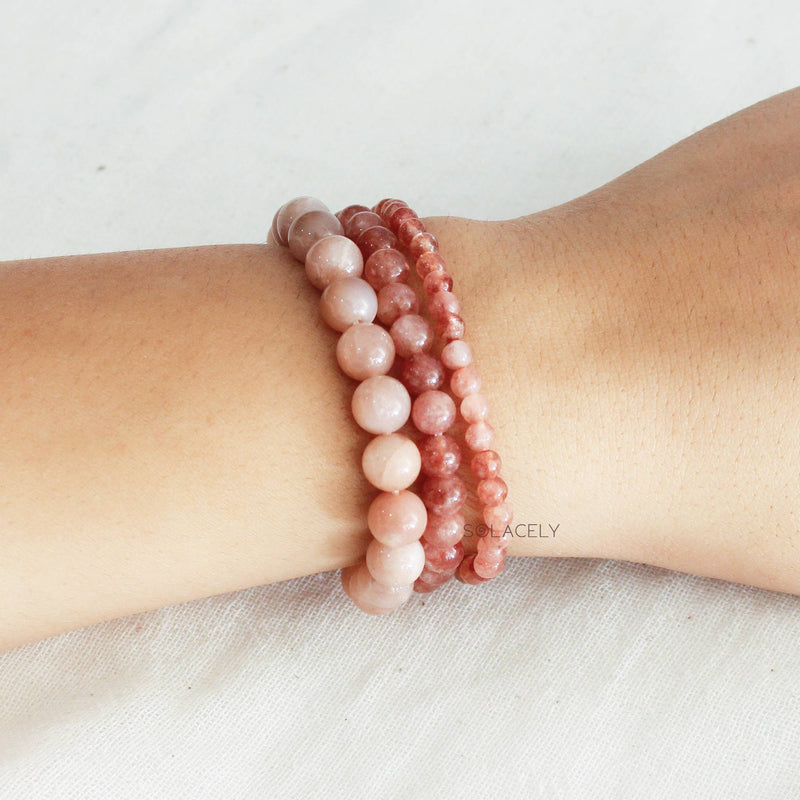
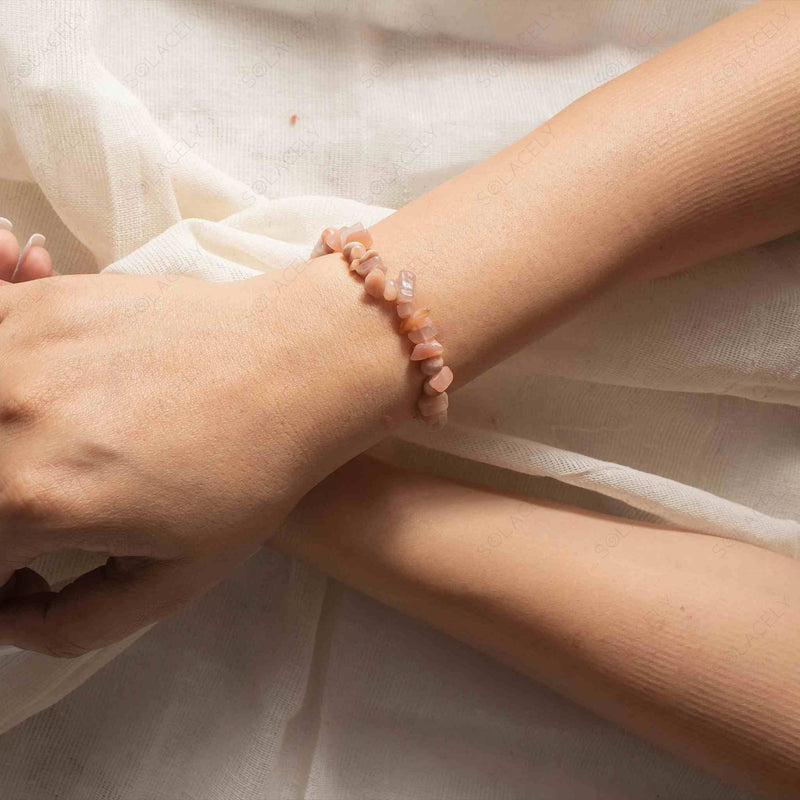
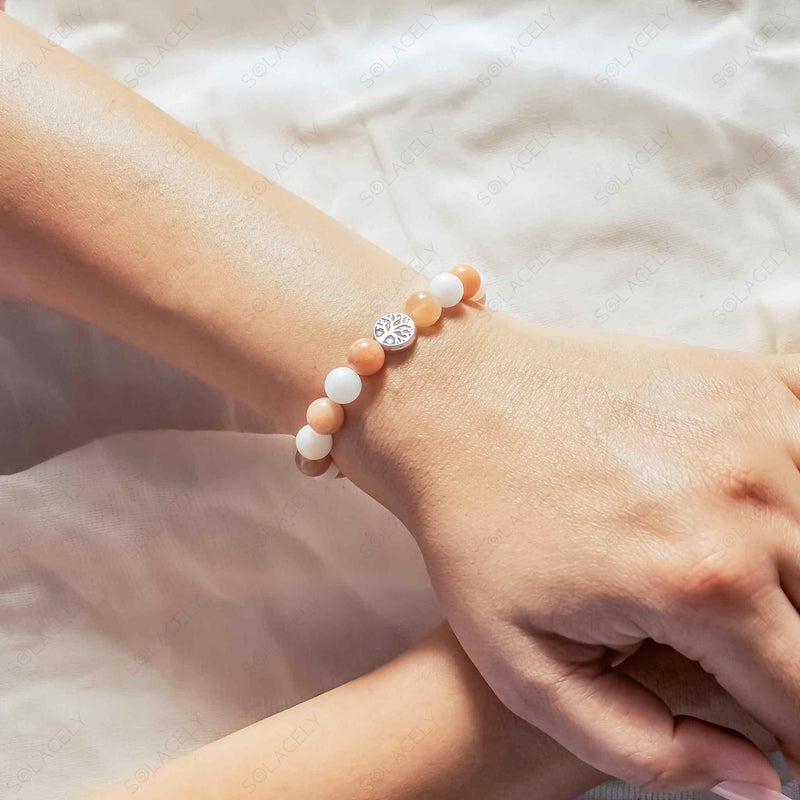
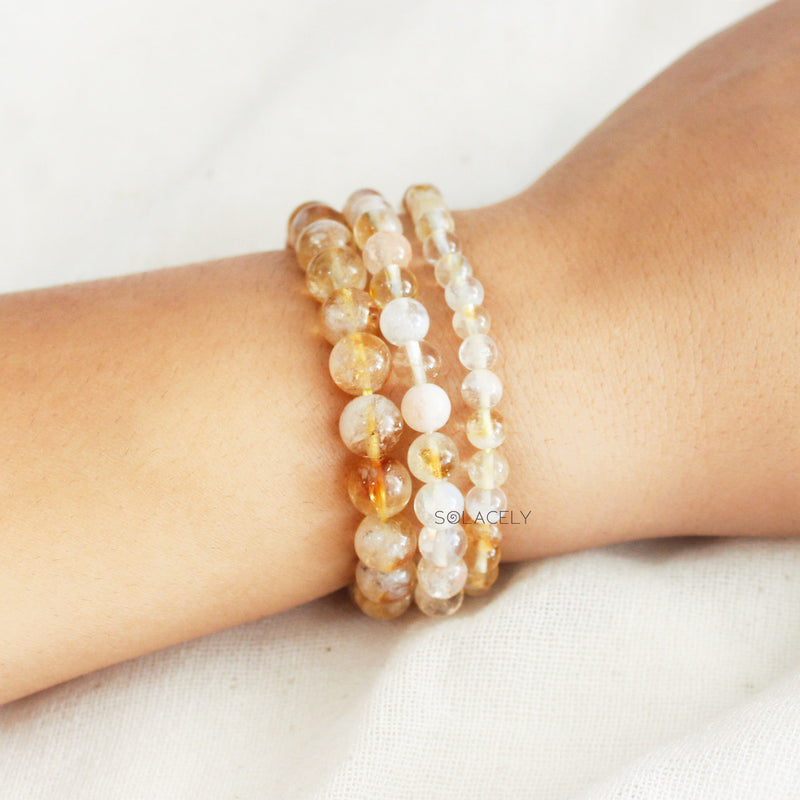
Sunstone is the stone people reach for when motivation has gone quiet. Long associated with the sun and with warmth, it is traditionally kept for lifting a flat stretch rather than for pushing through tiredness. Most wearers keep it somewhere they will meet it first thing in the morning.
Key takeaways
- Sunstone is a feldspar whose flash comes from tiny copper or hematite inclusions catching the light.
- Traditionally a daylight stone, worn while you are out and active rather than at night.
- Kept for warmth, motivation and optimism, particularly through the darker months.
- Moonstone is the classic partner, the two held together for day and night balance.
- Softer than quartz, so store it apart and give it indirect light.
What sunstone is
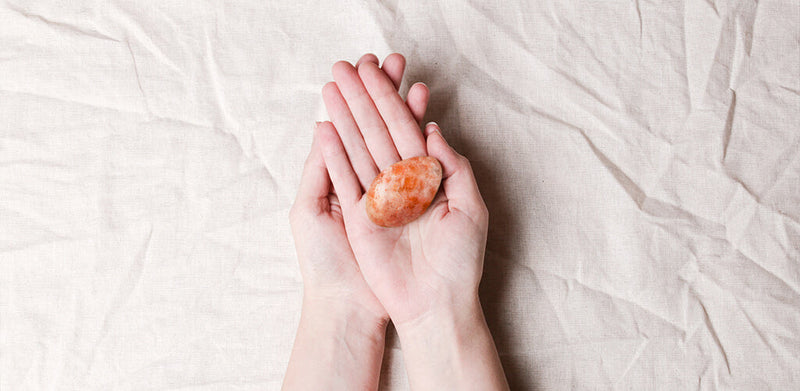
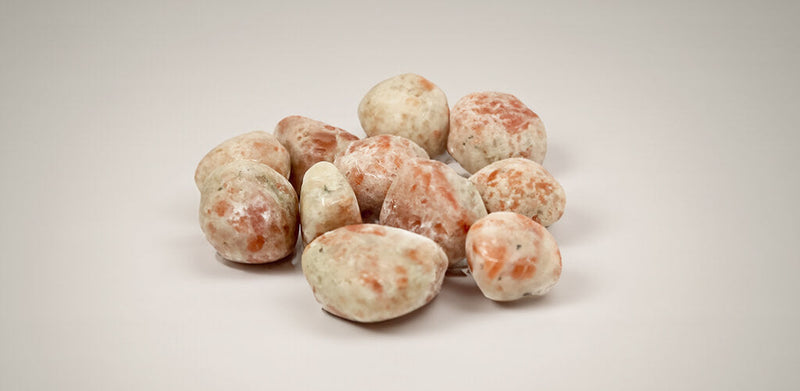
Sunstone belongs to the feldspar family, and what makes it sunstone rather than any other feldspar is the glitter. Tiny plate like inclusions of copper or hematite sit inside the stone, and as it turns they catch the light and throw a warm flash across the surface. Gemmologists call that effect aventurescence.
The colour runs from pale peach through amber to a deep brick red, and the flash can be a fine shimmer or bold visible flecks. Oregon sunstone, coloured by copper, is the variety most prized for the strength and evenness of its glow. Grading puts the highest value on a warm, even body colour with a flash that reads across the whole stone rather than in one patch.
That optical quality is the root of everything else. A stone that looks lit from inside was always going to be tied to the sun, and every tradition that met it made the same connection. Our fuller profile sits in the sunstone meaning and properties guide.
Why sunstone is kept for energy
Across Norse, Greek and Indian tradition, sunstone carried solar association: light, vitality, and the return of warmth. Norse lore connects it to navigation and to finding the sun on an overcast day, which is a fitting image for what people reach for it for now.
In crystal practice the distinction that matters is the kind of low you are in. Sunstone is traditionally chosen for a flat, grey, unmotivated stretch, the sort that arrives in February and has nothing to do with sleep. It is not the stone for physical exhaustion, where rest is the answer. People reach for it when the light has gone out of things rather than when the body is tired.
That is also why it is so strongly a winter stone in modern practice. Our sunstone for positivity guide covers the mood side, and crystals for energy and focus covers how it sits against the other stones in that group.
How to use sunstone day to day
- Put it on in the morning. Sunstone is a daylight stone by tradition, so the wearing is tied to the active part of the day.
- Keep it visible, not buried. A wrist or a desk beats a drawer. The point is that you meet it.
- Attach it to one moment. Touch it as you sit down to the thing you have been avoiding.
- Name one small thing. Not the whole day. The next twenty minutes.
- Take it off at night. Many people swap to moonstone or amethyst in the evening.
The daily swap is a real practice rather than a flourish. Wearing an activating stone into the evening works against winding down, and the changeover itself becomes a useful signal that the working part of the day has closed.
Where sunstone sits in the chakra system
Sunstone is placed at the sacral and the solar plexus, the two centres tied in yogic tradition to creativity, pleasure, drive and personal will. The orange and amber body colour is what puts it there, in the same way every colour correspondence in the system works.
In practice that means placement below the ribs rather than at the chest or head. Lying down with a piece just above the navel and breathing into that spot for ten minutes is the conventional session. Our sunstone and the chakras guide covers the placement work in more detail.
Pairing sunstone with other stones
| Pair with | Traditionally kept for |
|---|---|
| Moonstone | Day and night balance; the classic sunstone partner |
| Carnelian | Drive and starting things |
| Citrine | Confidence and asking for what you want |
| Clear quartz | A general companion that sits with anything |
| Amethyst | When the flat stretch comes with restlessness |
Sunstone and moonstone is the pairing worth knowing. The two are held as a complementary set, sun and moon, outward and inward, doing and resting, and pieces that combine both are among the most popular in the whole category. Keep combinations to two or three stones with a clear relationship rather than stacking every intention onto one wrist.
For nerve rather than warmth, the crystals for confidence selection is the more direct route.
Caring for sunstone
Sunstone is a feldspar and sits a little softer than quartz, so it wants slightly more care than a tumbled agate.
Clean it with warm water, a soft cloth and a full dry. Store it away from harder stones so the polish stays sharp, and keep it clear of knocks, since feldspars part more readily along their internal planes than quartz does. Avoid ultrasonic cleaners and steam.
Despite the name, indirect light suits it better than a long spell on a hot windowsill. For energetic cleansing, sound, smoke or a night of moonlight all work, and moonlight has a pleasing logic to it for a stone worn in daylight. Weekly is a comfortable rhythm for a piece in daily use.
Who sunstone suits
People going into winter, people coming out of a long grey patch, and anyone whose difficulty is enthusiasm rather than energy. It is also a common first crystal for people who find the darker protective stones too heavy and want something warm to start with.
It suits less well as a calming stone. Sunstone is an activating piece by tradition, so for evening use, sleep or anxiety most practitioners point elsewhere, to amethyst, howlite or lepidolite, and keep the sunstone for the morning.
Crystals are offered here for reflection and wellbeing as part of a long standing tradition. They are not a treatment for any medical condition and are not a substitute for professional care. If low mood or persistent tiredness is affecting your daily life, please speak to a qualified healthcare professional.
Sources
Written by Chetena Sharma. Reviewed by the Solacely editorial team.
Frequently asked questions
About the author


Written by Chetna Sharma, crystal healing practitioner and co-founder of Solacely. Chetna has worked with healing crystals for over a decade and curates Solacely's protective stone collection.