Blue crystals run from the palest sky tones through to deep midnight, and the group includes lapis lazuli, sodalite, aquamarine, blue lace agate, kyanite, apatite and angelite. They are traditionally kept for calm and for clear speaking, which is why so many people wear one on days that involve a difficult conversation.
Key takeaways
- Blue is a colour group rather than one mineral family, so a blue shelf can hold quartz, beryl, feldspathoid, phosphate and sulfate stones side by side.
- Lapis lazuli, sodalite and blue kyanite give the deep, saturated blues, while aquamarine, blue lace agate and angelite give the soft, pale ones.
- Hardness varies enormously across the group, from aquamarine at 7.5 to 8 down to angelite at around 3.5, so match the stone to how you plan to wear it.
- Blue stones are long associated with the throat chakra, and people reach for them before presentations, interviews and honest conversations.
- Angelite and celestite degrade in water and must never be soaked, and larimar can lighten after long spells in strong sun.
- Choose by the shade you actually want to look at every day, since the same stone name covers a wide spread of tones.
What makes a crystal blue?
Blue in crystals almost always comes from trace elements or from the way a mineral's own structure handles light. Iron gives aquamarine its blue, copper gives turquoise and larimar theirs, and in lapis lazuli the colour belongs to lazurite, a mineral that is blue by nature rather than by inclusion.
That difference in chemistry is why the blues look so unalike in the hand. Beryl blues such as aquamarine are transparent and watery. Feldspathoid blues such as sodalite are opaque and dense, often marbled with white veining. Phosphate blues such as apatite can be almost neon. Sulfate blues such as angelite and celestite are chalky and soft looking, with a matte, powdery calm to them.
Light source matters more with blue than with almost any other colour. Daylight tends to lift a blue stone towards green, while warm indoor bulbs pull it towards grey or violet. If you are choosing between two pieces, look at both under the lighting of the room where the stone will actually live, and pick the one that still reads blue to you there.
Twelve blue crystals at a glance
The twelve stones below cover almost everything you will meet on a blue shelf. The hardness column is the practical one. Anything at 6 or above copes with daily wear on a wrist, while the softer stones are far happier in a bowl, a pouch or a display piece. Traditional associations are given as they have been handed down.
| Stone | Colour range | Mohs hardness | Traditionally kept for |
|---|---|---|---|
| Lapis lazuli | Royal to inky blue with gold pyrite flecks | 5 to 5.5 | Truth, study, self knowledge |
| Sodalite | Denim to navy, veined with white | 5.5 to 6 | Logical thinking, steady nerves |
| Aquamarine | Pale sky to sea green blue | 7.5 to 8 | Courage, calm, clear speaking |
| Blue lace agate | Soft powder blue with white banding | 6.5 to 7 | Gentle communication |
| Blue kyanite | Pale streaky blue to strong blue blades | 4.5 to 7 | Alignment, honest expression |
| Blue apatite | Teal to vivid electric blue | 5 | Focus, motivation, appetite for work |
| Angelite | Chalky pale blue, often with white | 3.5 | Peace, quiet reassurance |
| Celestite | Very pale sky blue, usually in geodes | 3 to 3.5 | Stillness and rest |
| Larimar | Turquoise blue with white marbling | 4.5 to 5 | Softening and letting go |
| Blue tiger's eye | Steel blue to grey blue, silky sheen | 7 | Composure under pressure |
| Turquoise | Sky blue to blue green, often veined | 5 to 6 | Protection while travelling |
| Blue calcite | Pale, milky, slightly translucent blue | 3 | Winding down and resting |
The deep blues: lapis lazuli, sodalite and blue kyanite
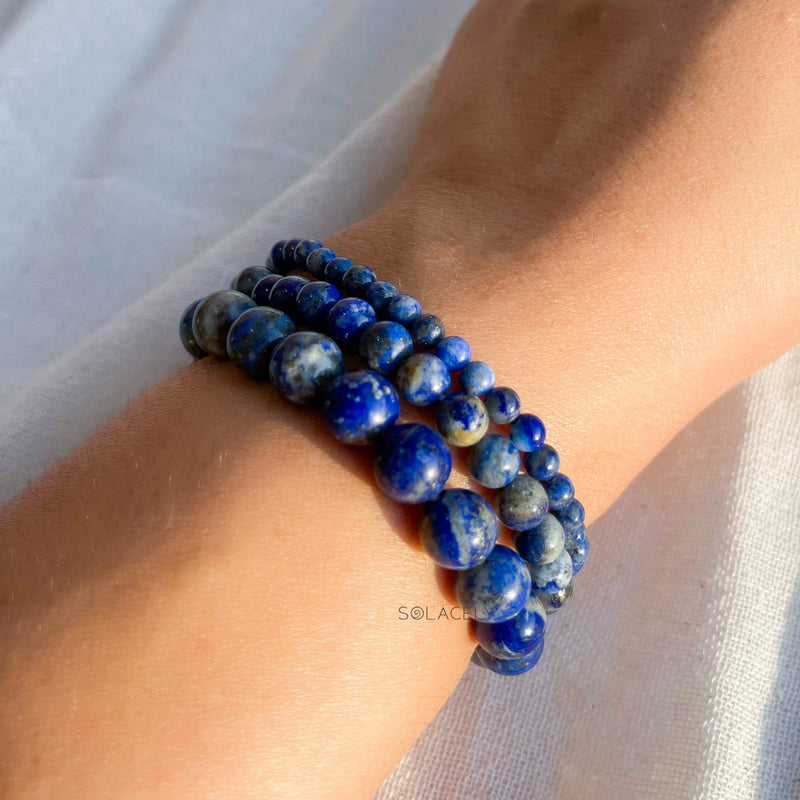
These three carry the strongest colour in the group. Lapis lazuli is a rock rather than a single mineral, made mostly of lazurite with calcite and flecks of golden pyrite. Sodalite is a sodium aluminium silicate from the feldspathoid group. Blue kyanite grows as long bladed crystals of aluminium silicate, striped along their length.
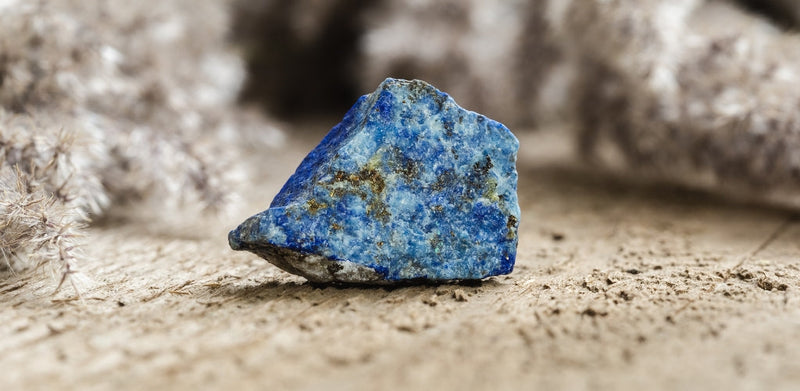
Lapis has been worked for ornament and pigment for thousands of years, and the classic material comes from the mountains of north eastern Afghanistan. At 5 to 5.5 on the Mohs scale it is a stone to treat gently, and its pyrite and calcite content means it prefers a dry cloth to a soak. People traditionally keep it for truth and for study, and our lapis lazuli guide covers formats and pairings in more detail.
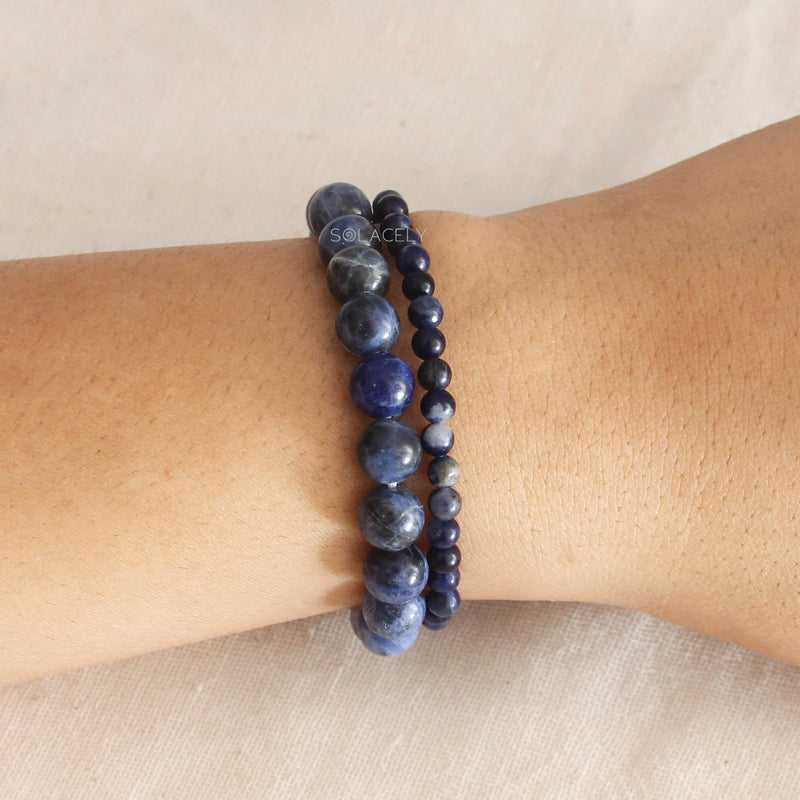
Sodalite reads as a calmer, more denim blue, marbled with white calcite veining, and it is a little harder than lapis, so it wears well as beads. It is long associated with orderly thinking, which is why it turns up so often in study bracelets. If you want the full picture on shades and origins, our sodalite guide goes stone by stone.
Blue kyanite is the curiosity of the three. Its hardness changes with direction, roughly 4.5 to 5 along the length of a blade and closer to 6.5 or 7 across it, which is a genuine consequence of how the crystal is built. Cutters and bead makers work with that grain rather than against it. Kyanite is traditionally kept for saying the thing you have been circling around.
The soft blues: aquamarine, blue lace agate and angelite
The pale blues are the ones people find most restful to look at. Aquamarine is the blue variety of beryl, coloured by trace iron. Blue lace agate is a banded chalcedony, which puts it in the wider quartz family. Angelite is the trade name for a massive form of anhydrite, a calcium sulfate that is soft and chalky to the touch.
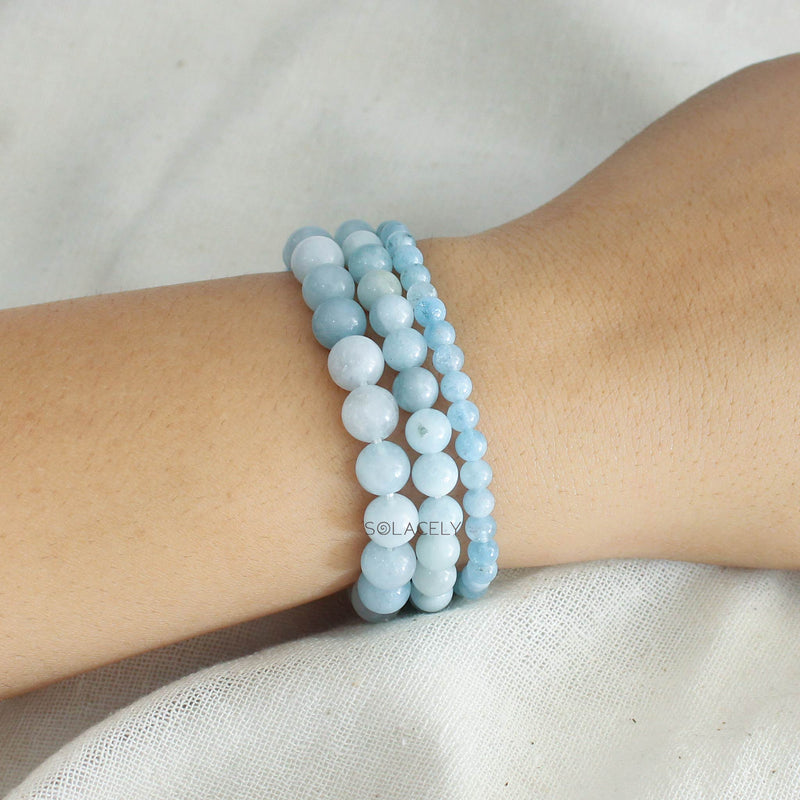
Aquamarine is by far the toughest stone on this shelf at 7.5 to 8 on the Mohs scale, which is why it is the blue most often set into rings worn every day. Gemmological grading rewards a pure, even blue with good transparency, and the stone is famous for growing in large, clean crystals. Our aquamarine guide covers what to look for in a bead strand.
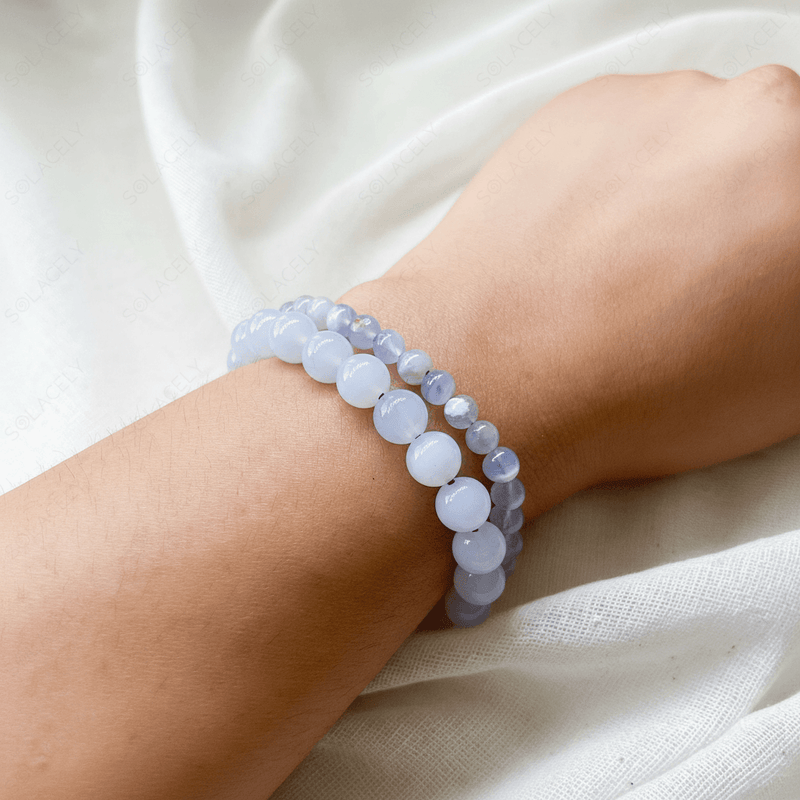
Blue lace agate is the gentlest looking of the group, with fine white banding curving through powder blue. Those bands are growth layers, laid down as silica rich fluid filled a cavity over a very long period, so no two beads match. It is traditionally worn as a reminder to speak softly and slowly, and it suits people who find the deeper blues a little heavy.
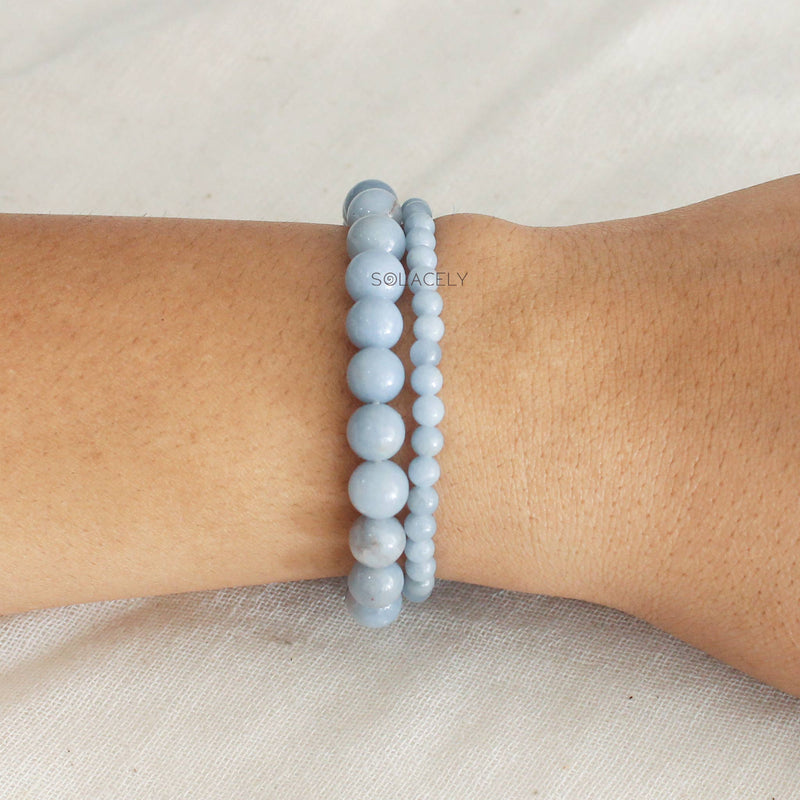
Angelite is beautiful and needs the most care. At around 3.5 on the Mohs scale it scratches easily against harder beads, and because it is a sulfate it degrades in water, so it must never be soaked, rinsed or worn in the shower. Keep it dry, store it on its own, and it will hold its soft blue for years. Celestite asks for exactly the same treatment.
The vivid blues: blue apatite, larimar and blue tiger's eye
These three sit between the deep and pale blues and each has a distinctive character. Blue apatite is a calcium phosphate that can run to an almost electric teal. Larimar is a blue variety of pectolite found in one area of the Dominican Republic. Blue tiger's eye, also called hawk's eye, is quartz with fine fibrous inclusions that produce a silky sheen.
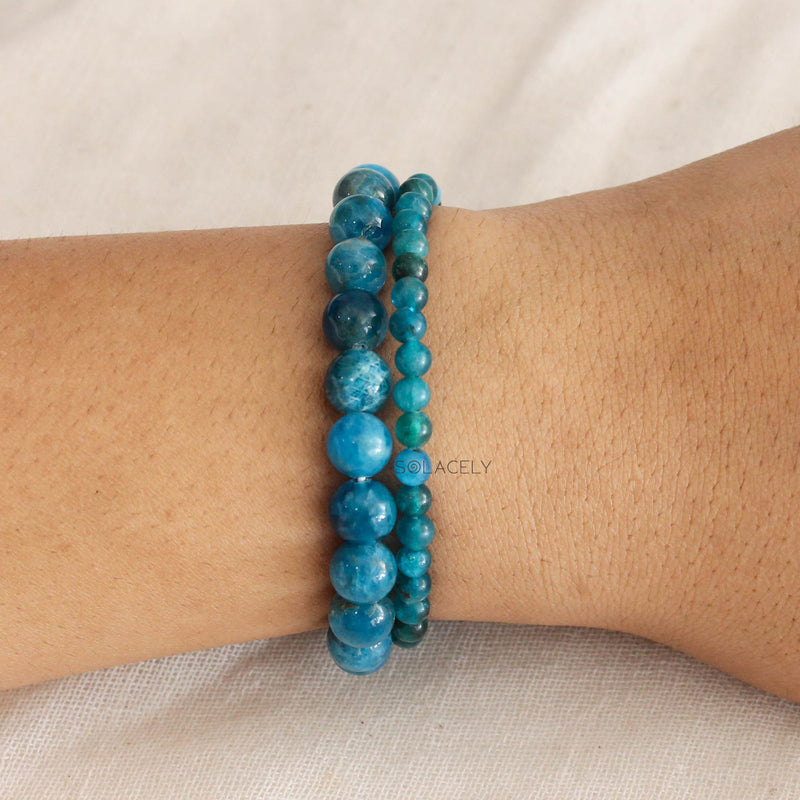
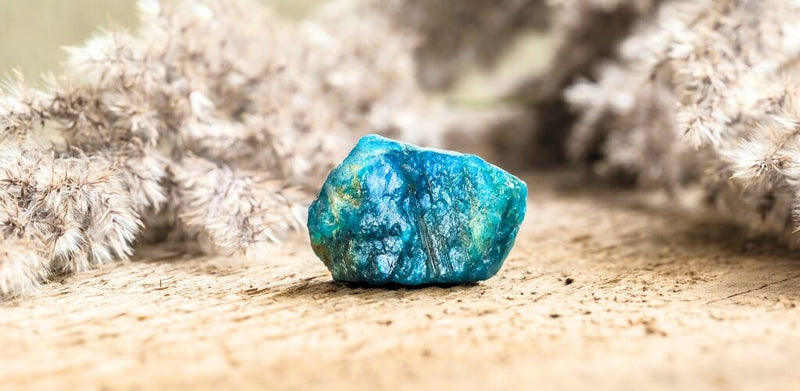
Blue apatite is a soft stone at 5 on the Mohs scale, so it belongs on a desk or in a pendant rather than in a bracelet you knock against door frames. Its colour range is wide, from muted teal through to saturated neon blue, and the strong colours photograph far better than they read in a dim room. People traditionally keep it for motivation and focus, as our blue apatite guide explains.
Larimar is prized for its pattern, a turquoise blue broken by white marbling that looks like light on shallow water. It sits around 4.5 to 5 on the Mohs scale and can lighten after long spells in strong sunlight, so it is best kept off a sunny windowsill and stored in a pouch between wears. Choose it by the marbling you like, since every cabochon is different.
Blue tiger's eye is the practical one. At 7 on the Mohs scale it takes daily wear easily, and the chatoyancy, that moving band of light across the surface, comes from parallel fibres inside the quartz. It is traditionally worn for composure, and the steel blue tone reads far more like a watch strap than a crystal, which suits people who want something discreet.
How to use blue crystals day to day
Most people use blue crystals in three ways: worn, held or placed. A bracelet keeps the stone in your line of sight before a meeting. A tumble in a pocket gives you something to reach for while you gather your thoughts. A cluster or sphere on a desk sets the tone of a workspace without asking anything of you at all.
The traditional association is with the throat chakra, the centre linked with speaking and being heard. In practice that means people place a blue stone at the base of the throat while lying down, hold one in the palms while breathing slowly, or simply keep one in a bag on a day they know will involve saying something difficult. Our guide to crystals for the throat chakra sets out a simple layout.
A useful habit is to pair the stone with a single sentence. Before a call, hold it for a few breaths and name the one thing you actually want to say. Stay with one stone for a few weeks rather than rotating the whole shelf, and you will get a far clearer sense of whether that particular blue suits you.
Caring for blue crystals
Blue stones need three things: separate storage, gentle cleaning and shade. The hardness spread in this group is wider than in almost any other colour, so an aquamarine bead will happily scratch an angelite or a blue calcite sitting next to it in a box. Keep bracelets flat in individual pouches and the problem disappears entirely.
For cleaning, a soft dry or barely damp cloth handles nearly everything. Quartz family blues such as blue lace agate and blue tiger's eye tolerate a brief rinse in cool water followed by a thorough dry. Angelite and celestite must stay dry altogether, as water breaks down the sulfate. Lapis lazuli and turquoise are porous and prefer a dry cloth, and the whole group should be kept away from ultrasonic cleaners and hot water.
Keep larimar and blue apatite out of long, direct sunlight so the colour stays as deep as the day you bought it. If you like to cleanse your pieces, moonlight, sound and dry salt placed on a plate beside the stone rather than touching it are all gentle options that avoid soaking. Never put stones in drinking water, and keep small beads, chips and tumbles away from babies and young children.
Crystals are kept for comfort, focus and ritual. They are not a medical treatment and nothing here is medical, psychological or safety advice. If you have a health concern, please speak to a qualified professional and carry on with any care that has already been arranged for you. Keep small stones, beads and chips away from babies, young children and pets, as they present a choking and strangulation risk.
Sources
- Geology.com, Sodalite: A Blue Gem Material and Ornamental Stone
- GIA, Aquamarine Quality Factors and Description
Written by Chetena Sharma. Reviewed by the Solacely editorial team.
Frequently asked questions
About the author


Written by Chetna Sharma, crystal healing practitioner and co-founder of Solacely. Chetna has worked with healing crystals for over a decade and curates Solacely's protective stone collection.