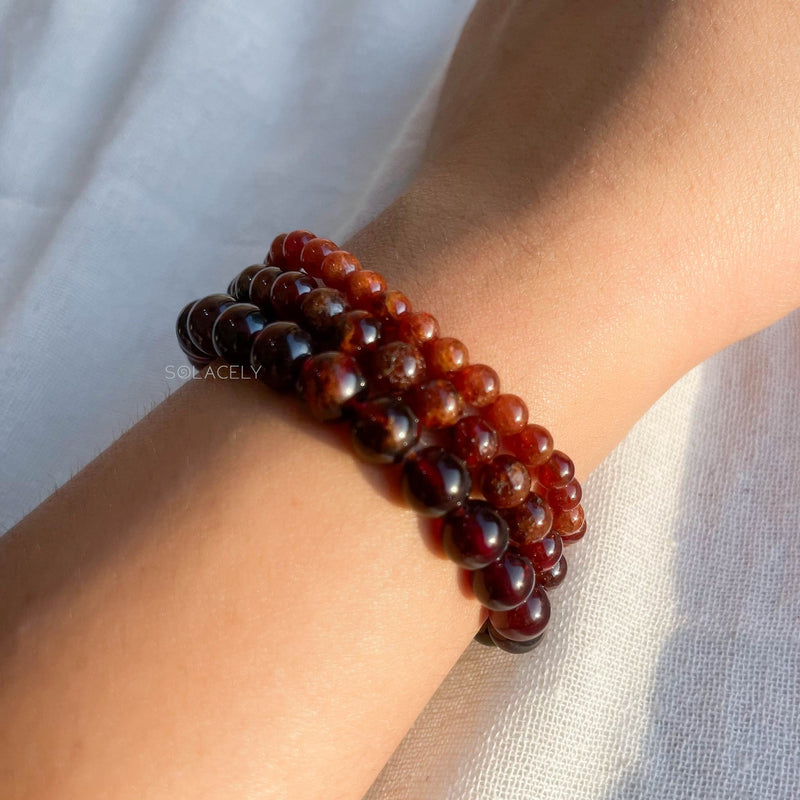
Choose 6mm if you are not sure. It is the middle size and it suits most wrists. Bead size changes how a bracelet looks and how much you feel it on your arm. It does not change what the stone is or what it is kept for. A 4mm hessonite bracelet is not a lesser one.
Key takeaways
- 4mm is the subtle one: a first remedy stone worn discreetly, and the natural choice for stacking.
- 6mm is the classic. It shows the honey-brown and the depth inside the stone without being a statement.
- 8mm is the statement, for larger wrists and for gifting.
- Bigger beads are not more powerful beads. Size is about preference, not potency.
- Measure your wrist, then match it to five sizes from S at 6 inches to XXL at 8 inches.
- Between two sizes, size up. A slightly loose elastic bracelet lasts longer than a tight one.
What bead size actually changes
Three things: how much of your wrist the bracelet occupies, how much you feel it as you move, and how it sits beside anything else you wear. That is the complete list. It does not change the mineral, and it does not change what hessonite is traditionally kept for.
It is worth saying plainly because gomed is a remedy stone, and people buying a remedy stone sometimes assume a bigger bead must be a stronger one. The tradition does not say that. A ring holds a single small stone and has been considered sufficient for centuries. Choose the size you will enjoy wearing, because the bracelet you keep on is the one that does the work of reminding you.
Our hessonite bracelet comes in all three bead sizes and five wrist sizes, hand-strung on elastic.
4mm, the subtle one
Small, light, and easy to forget you have on. This is the size for a first remedy stone worn discreetly, for anyone who wants hessonite present without it announcing itself, and for a wrist that already carries a watch or other bracelets.
At 4mm the honey-brown reads as a warm line rather than as individual beads, and it slips under a shirt cuff cleanly. It also stacks beautifully: a fine strand beside a bolder bracelet reads as a detail rather than a competitor. If you have been advised to try gomed for a few days before committing to it, a 4mm strand is the quietest way to do that; our hessonite (gomed) meaning and benefits guide explains that trial period and the tradition behind it.
6mm, the classic
The middle, and the one to choose if you are choosing blind. At 6mm each bead is large enough to show hessonite's colour properly, the warm honey to cinnamon brown with its characteristic depth, while the strand stays light enough to wear all day without thinking about it.
It is the size most people picture when they imagine a gomed bracelet. If this is your first crystal bracelet, start here. It is the safest size to like, and it works on almost every wrist.
8mm, the statement
For presence, for larger wrists, and for gifting. At 8mm the beads are substantial and the bracelet becomes part of how you are dressed rather than a quiet detail. The swirling texture inside a genuine hessonite bead is easiest to see at this size, which is part of its appeal.
Garnet is moderately dense, so an 8mm strand has a pleasant weight that many people find grounding. It suits a broad wrist, a men's stack, and anyone who likes to feel the piece they are wearing. If you spend the day at a keyboard and are torn, 6mm is the safer pick.
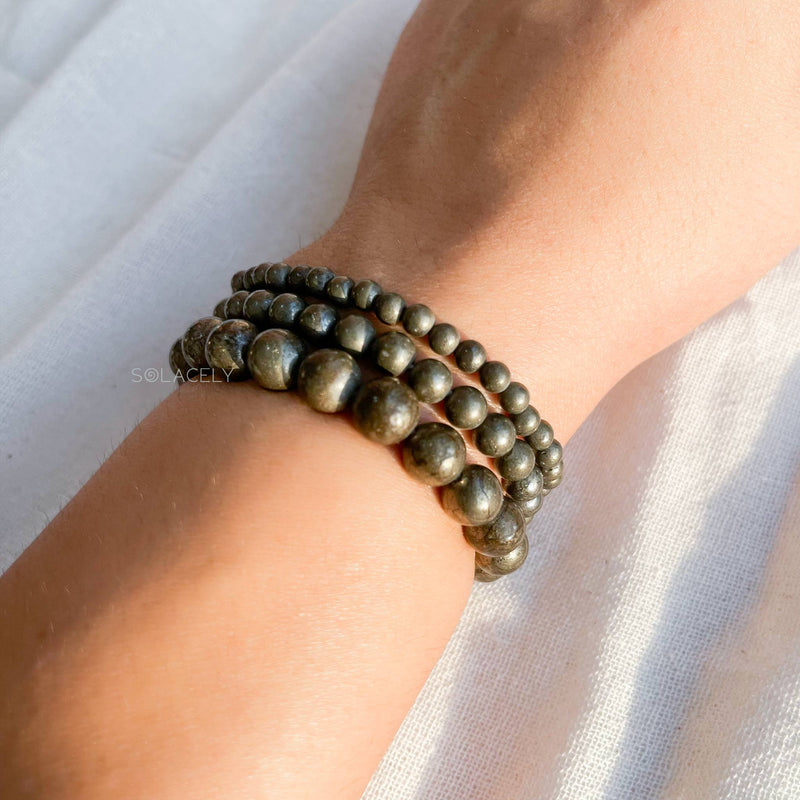
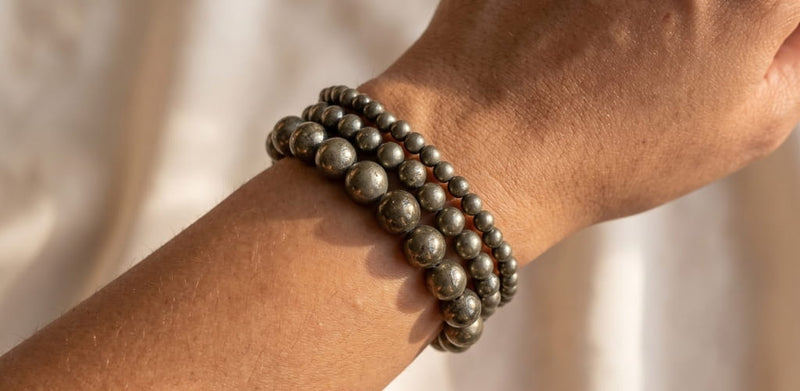
Pyrite wearers face the same three-way choice, and the thinking carries over. Our guide to choosing your pyrite bracelet bead size is the sibling to this one.
Measuring your wrist
Two minutes, and you only need a strip of paper.
- Wrap a strip of paper or a soft tape measure around your wrist, just below the wrist bone, where the bracelet will sit.
- Mark where the end meets, lay the strip flat, and read the measurement in inches.
- Add roughly a quarter to half an inch so the bracelet moves comfortably rather than gripping.
- Match that figure to the size chart below.
| Size | Bracelet length |
|---|---|
| S | 6.0 inches |
| M | 6.5 inches |
| L | 7.0 inches |
| XL | 7.5 inches |
| XXL | 8.0 inches |
Bead size does not change the wrist size you need, though 8mm beads stand further off the wrist than 4mm ones, so a snug fit feels snugger.
Between two sizes? Size up.
Always. An elastic bracelet that sits a little loose will outlast one that is stretched taut every time you put it on, because the cord is under less tension at rest and less strain going over your hand. A looser fit also lets the beads turn, which is how the depth inside hessonite catches the light.
The right size is the one you stop noticing
If you wear hessonite as Rahu's stone, the tradition is more interested in continuity than in size: a trial of a few days, then the stone stays on. A bracelet you find comfortable is the one you will keep wearing, which makes comfort the sensible choice on every count.
There is no wrong answer in a dropdown of three numbers. The right size is the one that stops being a decision the moment it is on your wrist, and then catches the light weeks later, honey-brown in a meeting, and reminds you what you put it on for.
Choose for comfort, size up if you are torn, and let the stone do the rest. From our space to yours.
The uses described here reflect traditional Vedic and cultural crystal practice. They are not medical claims and are not a substitute for professional healthcare, financial or legal advice, or for a reading from a qualified astrologer. Keep small beads away from young children and pets, as loose beads are a choking risk.
Sources
Written by Chetena Sharma. Reviewed by the Solacely editorial team.
Frequently asked questions
About the author


Written by Chetna Sharma, crystal healing practitioner and co-founder of Solacely. Chetna has worked with healing crystals for over a decade and curates Solacely's protective stone collection.