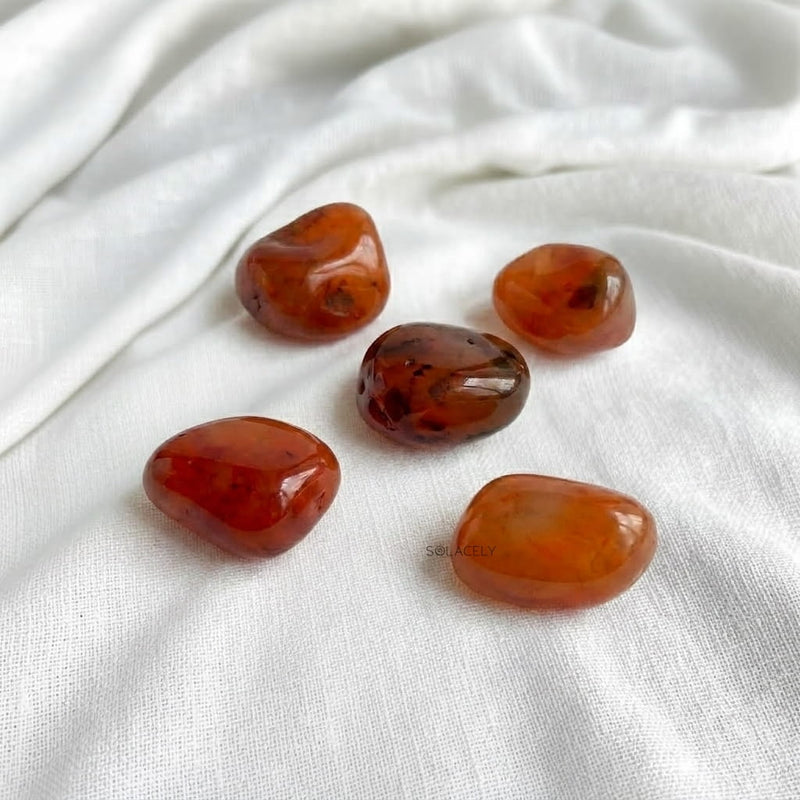
Ruby is the birthstone for July. It is the red variety of corundum, coloured by traces of chromium, and at 9 on the Mohs scale it is one of the hardest stones you can wear every day. Carnelian and onyx are the traditional July companions, chosen when you want the same warm spirit in a stone you can keep in quantity.
Key takeaways
- July's birthstone is ruby, the red form of the mineral corundum, with chromium giving the colour its glow.
- Ruby sits at 9 on the Mohs scale, second only to diamond, which is why it holds up so well in rings and daily-wear jewellery.
- Carnelian and onyx have travelled with July since the older gem calendars, and both remain warm, wearable choices for a July birthday.
- Ruby zoisite carries ruby's red inside a green zoisite matrix, so it is an easy way to keep the July stone on your wrist.
- Ruby is long associated with courage, vitality and wholehearted living, which is why it has been kept by soldiers, rulers and romantics alike.
- Warm soapy water and a soft brush suit the whole July group; keep carnelian out of long, direct sun so its orange stays deep.
What is the July birthstone?
The birthstone for July is ruby. It has held the July place in the modern list that jewellers standardised in 1912, and its link with the month reaches back much further through older gem calendars. Ruby is the red variety of corundum; the same mineral in blue, yellow or pink is called sapphire.
That single mineral covers an enormous range of reds. A July ruby can run from a light, slightly pinkish red through to a deep red with a purple undertone, and every shade of that range has been worn and loved by someone. Nothing about the month prescribes one tone over another, so the choice is genuinely yours to make.
If you are buying for a family with birthdays scattered across the calendar, our birthstones by month guide lays out the full twelve in one place, including which months carry more than one recognised stone.
Why ruby became the stone for July
Ruby's association with July grew out of two long threads. The first is colour: red has stood for heat, vitality and courage across most gem traditions, and July sits at the height of northern summer. The second is astrology, where ruby has long been tied to the sun, the body that dominates the July sky.
In Sanskrit, ruby carries the name Ratnaraj, the king of gems, which tells you how it was ranked among the stones people knew. Burmese, Indian and medieval European traditions all handed down similar ideas about it: that it steadied the wearer, kept courage close in a difficult moment, and marked the person carrying it as someone of standing.
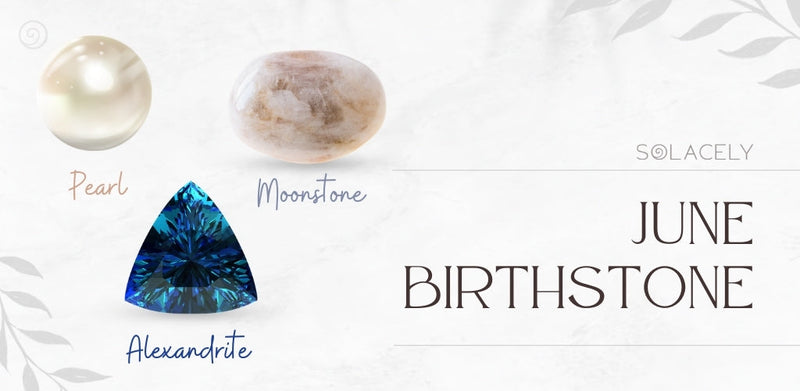
Those meanings are what people still reach for today. Ruby is worn as a reminder to act wholeheartedly, to say the thing rather than sit on it, and to stay warm towards yourself when a year has been hard. It makes a natural contrast with the cool, lunar mood of the June birthstone that comes just before it.
What ruby actually is
Ruby is aluminium oxide with a trace of chromium sitting in the crystal structure. Chromium is what makes it red rather than blue or colourless, and it also gives many rubies a soft glow under ultraviolet light. Remove the chromium and the same mineral would be sapphire, which is why the two are so often discussed together.
The crystals grow slowly in metamorphic rock, most famously in marble, and also in some basalts. Marble-hosted material is low in iron, and low iron lets the red read as bright and saturated rather than dark. Iron-richer settings give a deeper, browner red that many people actually prefer in a larger piece of jewellery.
Gemmological grading puts colour first for ruby, ahead of clarity, and the trade term for the most saturated slightly purplish red is pigeon's blood. Inclusions are expected rather than avoided: fine needles inside the stone are part of how ruby forms, and in the right arrangement they produce the six-rayed star seen in star ruby cabochons.
Heat has been part of the ruby craft for centuries. It is a settled, permanent step that brings the red forward and stays put for the life of the stone, and it is one reason ruby jewellery has been passed down through generations intact. The practical question when you buy is simply which shade of red you want to look at every day.
Carnelian and onyx, July's traditional companions
Long before the modern list settled, gem calendars circulating in Europe and the Middle East placed carnelian and onyx alongside July. Both are chalcedony, both take a beautiful polish, and both come in sizes and formats that ruby rarely does. Many people born in July keep one of these as their everyday stone and save ruby for a special piece.
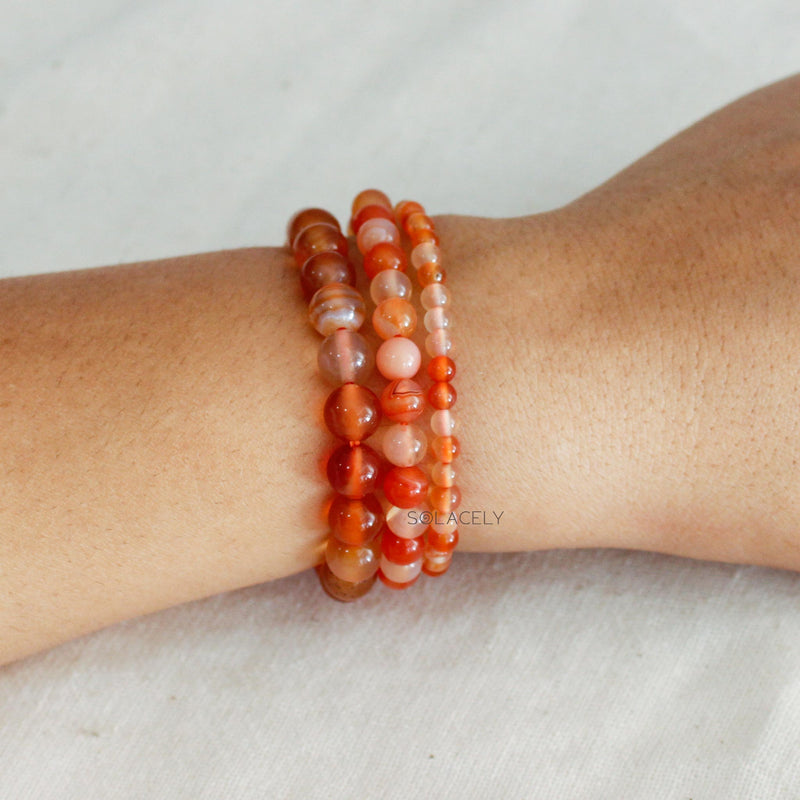
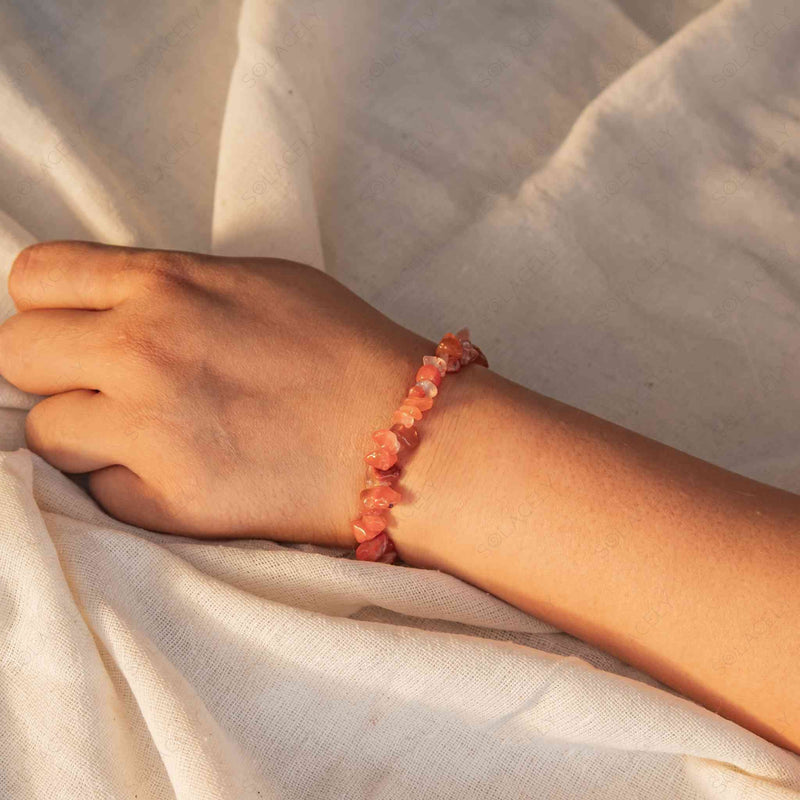
Carnelian is the warm one. Its orange to red-brown colour makes it the closest match to ruby's mood, and it is traditionally kept for drive, creative confidence and getting started on something. Our carnelian meaning and properties guide covers how people work it into a morning routine.
Onyx is the steady one. Its deep, even black is long associated with boundaries, focus and holding your ground, which balances ruby's forward push rather nicely. If that is the quality you want from a July piece, the black onyx guide goes into its formats and pairings.
| Stone | Colour | Mohs hardness | Traditionally kept for |
|---|---|---|---|
| Ruby | Light red to deep purplish red | 9 | Courage, vitality, wholehearted living |
| Ruby zoisite | Red patches in green, with black flecks | 6 to 7 | Energy with a grounded edge |
| Carnelian | Orange to red-brown | 6.5 to 7 | Drive, creativity, confidence |
| Black onyx | Even black, sometimes banded | 6.5 to 7 | Focus, steadiness, boundaries |
Ruby zoisite and raw stones for everyday wear
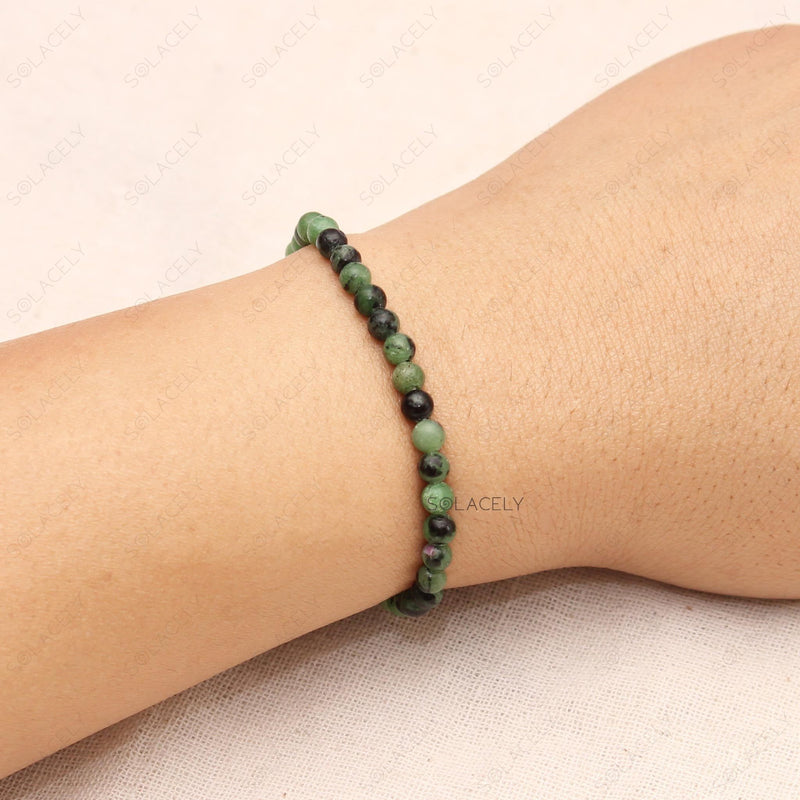
Faceted ruby usually arrives in small sizes and formal settings, so it is not always what you want on a wrist. Ruby zoisite solves that neatly. It is a single rock carrying red ruby crystals inside green zoisite, with black hornblende flecks running through it, and it comes in beads big enough to read across a room.
A ruby zoisite bracelet gives you July's stone in a form you can wear to work, to the gym and to bed if you want to. The red and green sit together in every bead, which is part of the appeal: people reach for it when they want ruby's warmth without losing their footing, and it wears far better than a delicate setting on a busy day.
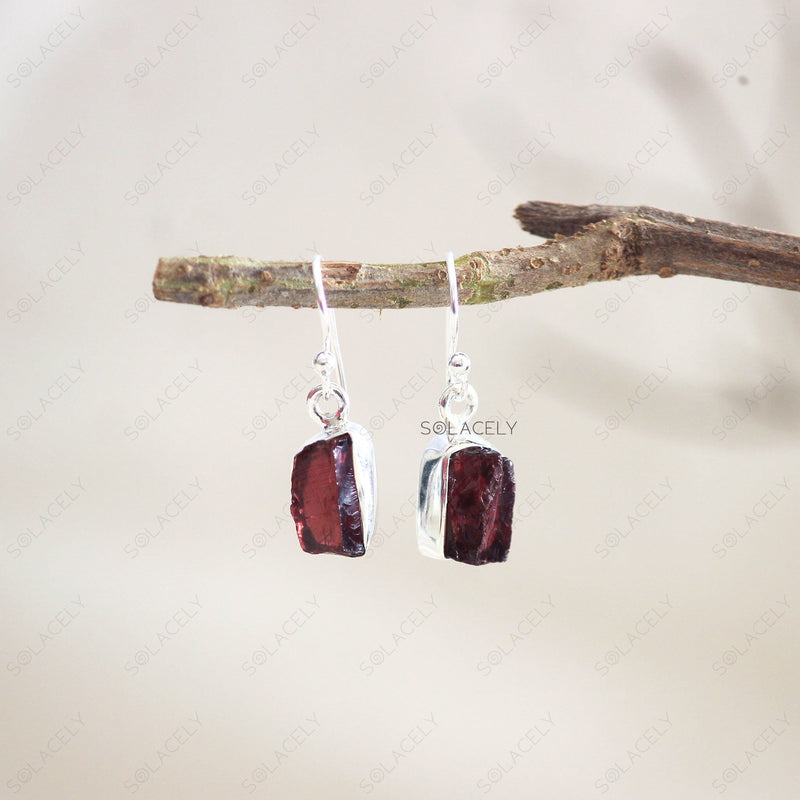
Raw crystal jewellery is the other honest route. An unpolished point in a simple sterling silver drop keeps the stone's natural faces visible, which suits people who would rather see the crystal as it grew than as it was cut. Either way, keep the piece somewhere you will actually see it, because a stone you notice becomes a daily cue and a stone in a drawer does not.
Choosing a July stone as a gift
Start with what the person will wear rather than with the price list. A ruby set in a ring or pendant is the classic fortieth-anniversary and milestone-birthday gift. A ruby zoisite or carnelian bracelet suits someone who wants the meaning present every day without thinking about it. Both are legitimate July gifts.
Colour preference matters more than anything a chart can tell you. Some people want the brightest red they can find; others prefer a deep, wine-dark stone that reads almost purple in low light. Ask, or look at what they already wear, and match that. A stone in a shade they love gets worn, and a stone that gets worn does its job.
For families with back-to-back summer birthdays, pairing July's red with the green of the August birthstone makes a striking two-stone gift. Ruby zoisite does something similar inside a single piece, which is why it works so well as a shared present between siblings born a month apart.
Caring for ruby, carnelian and onyx
The whole July group is straightforward to look after. Warm water, a drop of mild soap and a soft brush will clean ruby, carnelian, onyx and ruby zoisite alike. Rinse, then dry thoroughly with a soft cloth. Skip ultrasonic cleaners and steam across all four, and skip household chemicals entirely.
Ruby's hardness cuts both ways. At 9 on the Mohs scale it shrugs off the knocks that would mark a softer stone, but it will happily scratch the beads sitting next to it. Store ruby pieces in their own pouch or a lined compartment rather than loose in a jewellery box with everything else.
Carnelian holds its colour best out of long, direct sunlight, so a bright windowsill is the one place not to leave a bracelet between wears. Take rings off for gardening, cleaning and swimming, since it is the setting rather than the stone that usually gives way. Never put any stone in drinking water, and keep small beads, chips and tumbles well away from babies, young children and pets.
Crystals are kept for comfort, focus and ritual. They are not a medical treatment, and nothing here is medical, psychological or financial advice. If you have a health concern, please speak to a qualified professional and carry on with any care that has already been arranged for you. Keep small stones, beads and chips away from babies, young children and pets, as they present a choking and strangulation risk.
Sources
Written by Chetena Sharma. Reviewed by the Solacely editorial team.
Frequently asked questions
About the author


Written by Chetna Sharma, crystal healing practitioner and co-founder of Solacely. Chetna has worked with healing crystals for over a decade and curates Solacely's protective stone collection.