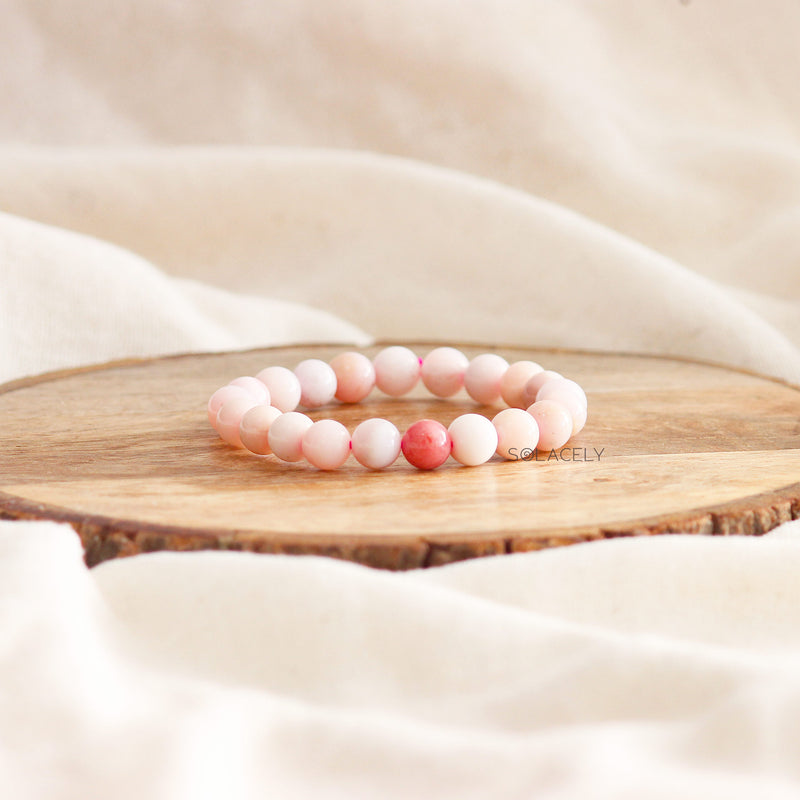
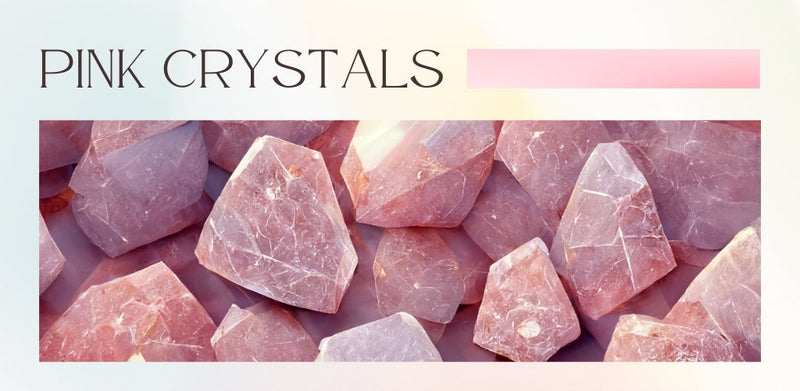
Pink opal is a soft, translucent common opal, best known from Peru, prized for an even milky rose colour and a quiet satin glow. It is traditionally kept for gentle emotional comfort and heart centred calm, and its steady, undemanding look makes it one of the easiest pink stones to live with every day.
Key takeaways
- Pink opal is a natural common opal, a hydrated silica that holds water inside its own structure.
- It is a body colour opal rather than an iridescent one, so its appeal is a smooth, even rose tone with a soft satin to glassy sheen.
- Peru is the source most people picture, with smaller amounts coming from Mexico, Australia and the United States.
- It sits around 5.5 to 6.5 on the Mohs scale, which is comfortable for pendants and beads and asks for a little more care in rings.
- Long associated with the heart chakra, it is worn as a daily cue for self kindness, steadiness and softer conversations.
- Because opal carries water, keep it away from heat, very dry air and ultrasonic cleaners, and slip rings off before washing up.
What pink opal is
Pink opal is a natural opal with a solid body colour: hydrated silica, written as SiO2 with water held within the structure. It belongs to the common opal family, the branch valued for an even, saturated colour and a soft internal glow rather than for flashes of spectral light across the surface.
That water content is the detail worth remembering. Opal is not built from a repeating crystal lattice in the way quartz is. Instead it is made of tiny spheres of silica packed together with water sitting between and within them, which is why gemmological references classify it as a mineraloid rather than a mineral. Water typically makes up a few per cent of the stone, and in some material considerably more.
Visually, pink opal reads as calm. The colour runs from a pale, almost powdery rose through to a deeper salmon or coral pink, often with white or pale grey cloudiness drifting through it and, in some Peruvian material, fine dark dendritic markings that look like tiny ferns. The polish gives a waxy to gently glassy lustre that sits close to the surface, so the stone glows rather than sparkles.
It is worth separating pink opal from pink opalite, a man made glass that has built up its own following for its milky, slightly bluish shimmer. Both have their admirers and both turn up in the same jewellery cases, but they start from different places, and our guide to pink opalite and rose quartz covers that material on its own terms.
Where pink opal comes from
Peru is the source most closely tied to pink opal. The material is mined in the Andes, and the country's name comes up so often alongside the stone that Peruvian pink opal has become the reference point for the shade most buyers picture. Mexico, Australia and parts of the United States produce it too, in smaller quantities.
Peruvian deposits also yield the well known blue green opal that sits alongside the pink in the same trade. Because both are body colour opals from the same region, they are frequently sold side by side and set together, and a strand mixing the two is a familiar sight in Andean jewellery.
The pink itself is generally attributed to trace mineral content within the silica, which is why colour varies from one pocket of material to another and even along a single strand of beads. Rather than looking for uniformity, most people choose by the tone they actually want on their wrist: cool and powdery, or warm and coral leaning.
Pink opal meaning and what it is traditionally kept for
Pink opal is long associated with the heart chakra and with gentle emotional comfort. People reach for it during periods of grief, tiredness or overwork, and wear it as a daily reminder to be kinder to themselves. Where rose quartz is often described as open hearted, pink opal is usually described as quietly steadying.
In crystal tradition the stone is grouped with the softening rather than the energising ones. It is the piece people put on before a difficult conversation, keep in a pocket during a stressful week, or place on a bedside table as part of a wind down routine. The intention most often set with it is simple: less self criticism, more patience.
It is also traditionally connected with emotional recovery, which is why it appears so often in collections built around the heart. If you are assembling a set with that theme, our guides to crystals for emotional healing and to the wider family of pink crystals show how pink opal fits alongside its neighbours.
Pink opal compared with other soft pink stones
Buyers usually decide between four or five pink stones, and the practical differences come down to hardness, look and the traditional association each one carries. The table below lines them up so you can match the stone to how you actually plan to wear it, whether that is a daily bracelet or an occasional pendant.
| Stone | Look | Mohs hardness | Traditionally kept for | Care note |
|---|---|---|---|---|
| Pink opal | Even milky rose, satin glow | 5.5 to 6.5 | Gentle emotional comfort | Keep from heat and dry air |
| Rose quartz | Cloudy pale pink, glassy | 7 | Self love, open heartedness | Keep out of long direct sun |
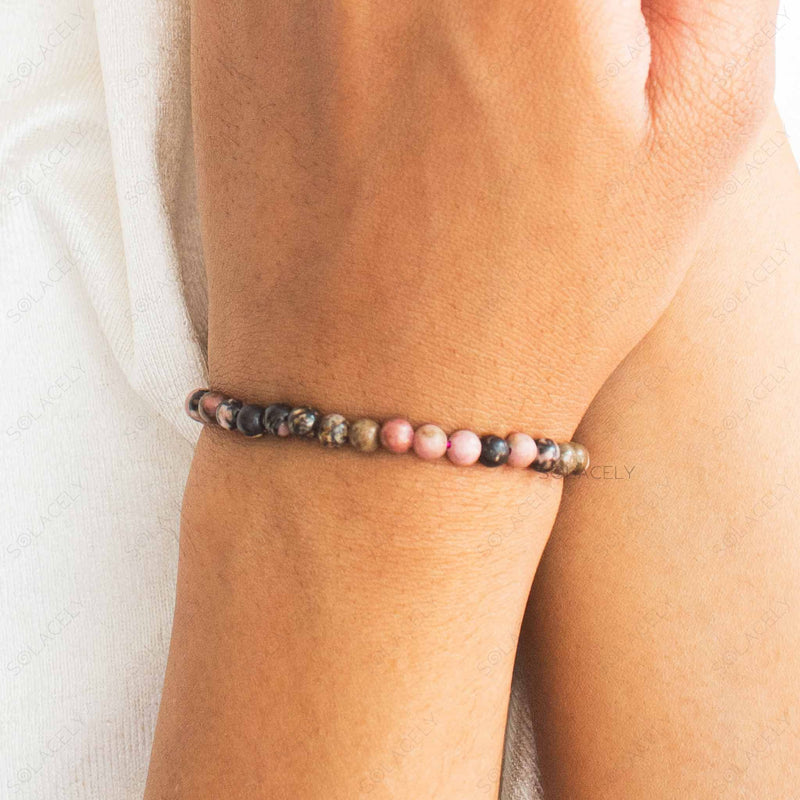
| Rhodonite | Pink with black veining | 5.5 to 6.5 | Forgiveness and steadiness | Store away from harder beads |
| Kunzite | Lilac pink, transparent | 6.5 to 7 | Tenderness after loss | Colour softens in strong light |
| Morganite | Peach pink, transparent | 7.5 to 8 | Calm affection | Hardy, avoid knocks on facets |
Pink opal earns its place in that list on look rather than hardness. Nothing else in the group gives you that smooth, even, low key rose across a whole bead, and because the colour is a body colour it stays consistent from every angle instead of shifting as you turn your wrist.
Pairing pink opal with other stones
Pink opal pairs most naturally with stones that share its register. Rose quartz is the obvious partner and the pairing most people start with, since both are traditionally kept for the heart. Rhodonite adds a little more backbone, and moonstone brings a similar softness in a cooler, silvery key.
For a set worn through a hard week, many people combine pink opal with rose quartz for warmth and one grounding stone, such as smoky quartz or hematite, so the whole thing is not purely soft. Keep the harder beads on a separate strand, since quartz and hematite will mark opal over time if they are strung tight against it.
If the intention is specifically emotional recovery, pink opal and rose quartz are usually the two chosen together, and our piece on rose quartz for emotional healing sets out how people build that routine. For a pairing with more structure to it, rhodonite is the usual next step.
How to wear and use pink opal
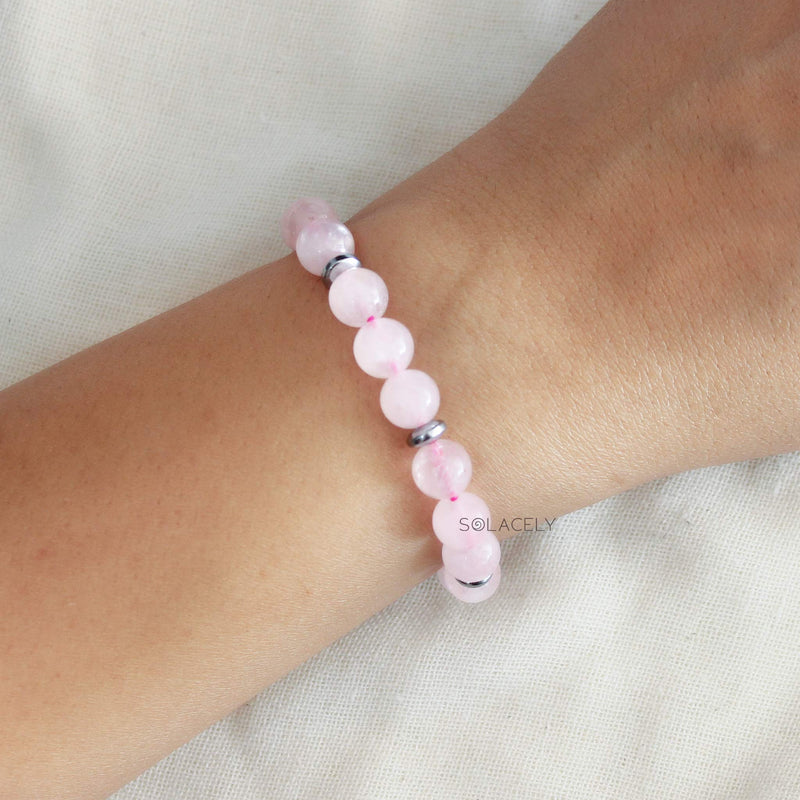
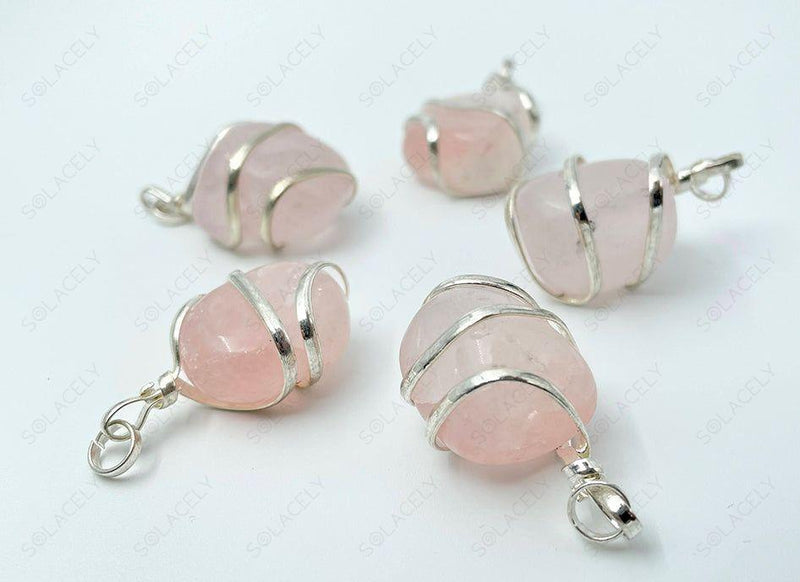
Most people use pink opal in one of three ways: worn as a bracelet or pendant, carried as a tumble, or placed somewhere it will be seen. At 5.5 to 6.5 on the Mohs scale it is well suited to pendants, earrings and beads, and comfortable in rings provided you are willing to take them off for rough work.
Worn, its job is to be a cue. A bracelet in your line of sight through a working day is a small, repeated reminder of whatever you set it for, which is usually patience with yourself. A pendant sitting at the chest is the traditional placement, given the heart chakra association, and it keeps the stone against skin and out of the way of knocks.
Held or placed, pink opal suits slower moments. Rest it in the palm for a few slow breaths at the end of the day, keep a tumble on a bedside table or a desk, or add it to a small arrangement with rose quartz when you want a corner of a room to feel softer. Pick one piece and stay with it for a few weeks rather than rotating through a shelf, and you will get a much clearer sense of whether it suits you.
Caring for pink opal
Opal holds water inside its structure, and that single fact drives every care rule for it. Keep pink opal away from heat, very dry air and sudden temperature changes, never put it through an ultrasonic or steam cleaner, and take rings off before washing up, cleaning or handling anything with solvents in it.
The specific thing being avoided is crazing, the fine network of surface cracks that can develop in opal if the stone dries out or is heated. Practical steps are straightforward: do not leave pieces on a sunny windowsill, next to a radiator, in a hot car or in an airing cupboard, and do not wear opal jewellery in a sauna, a hot tub or under a hairdryer.
For cleaning, a soft cloth with a little cool water is all that is needed, followed by a proper dry. Skip detergents, jewellery dips and anything abrasive. Store pieces in a soft pouch away from harder stones such as quartz and hematite, which will scratch opal if they rub against it in a box or on the same strand.
If you like to cleanse and charge your pieces, choose the dry methods. Moonlight, sound, incense smoke and resting the stone beside selenite are all gentle. Avoid long soaks, salt water and strong direct sunlight. Kept sensibly, a pink opal piece will hold its colour and its satin surface for many years.
Crystals are kept for comfort, focus and ritual. They are not a medical treatment, and nothing here is medical or psychological advice. If you have a health concern, please speak to a qualified professional and carry on with any care that has already been arranged for you. Keep small stones, beads and chips away from babies, young children and pets, as they present a choking and strangulation risk.
Sources
Written by Chetena Sharma. Reviewed by the Solacely editorial team.
Frequently asked questions
About the author


Written by Chetna Sharma, crystal healing practitioner and co-founder of Solacely. Chetna has worked with healing crystals for over a decade and curates Solacely's protective stone collection.