Gold crystals are stones whose colour sits in the yellow to golden brown range: citrine, pyrite, tiger's eye, golden rutilated quartz, imperial topaz, gold sheen obsidian, amber and sunstone. They are grouped by that warm colour rather than by chemistry, and traditionally kept for abundance, confidence and warmth.
Key takeaways
- Citrine is the yellow to orange variety of quartz, Mohs 7, and shares November birthstone status with topaz.
- Pyrite is an iron sulphide, Mohs 6 to 6.5, with a brassy metallic lustre and natural cube crystals. It must stay dry.
- Imperial topaz is the hardest stone on the list at Mohs 8, but it has perfect cleavage in one direction, so it dislikes knocks.
- Amber is the softest at Mohs 2 to 2.5, because it is fossilised tree resin rather than a mineral.
- Tiger's eye, golden rutilated quartz and citrine all sit at Mohs 7 and take everyday wear well.
- As a group, gold crystals are traditionally kept for abundance, confidence and warmth, and linked with the solar plexus.
What are gold crystals?
Gold crystals are a colour group, not a mineral family. The warm tone arrives by different routes: traces of iron in quartz, fibrous inclusions in tiger's eye, glittering platelets in sunstone, and the brassy metallic surface of pyrite. What they share is the look, and the intentions people attach to it.
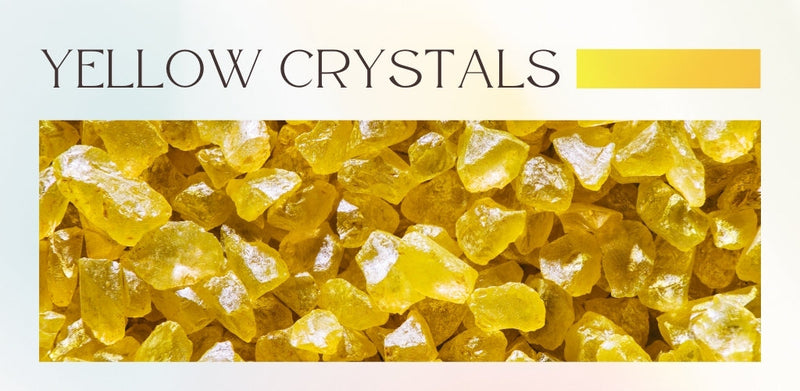
That mix is what makes the group interesting. One shelf of gold crystals can hold a fossilised tree resin, a volcanic glass, a feldspar and three kinds of quartz, all reading as the same shade from across the room. If you prefer to shop by colour rather than by mineral name, our guide to yellow crystals and their meanings covers the paler end of the same spectrum.
So which stones actually make the list? Eight come up again and again.
Which stones count as gold crystals?
Eight stones carry the label most often: citrine, pyrite, tiger's eye, golden rutilated quartz, imperial topaz, gold sheen obsidian, amber and sunstone. Their hardness runs from 2 up to 8 on the Mohs scale, which is a wide spread, and it decides almost everything about how you wear and store them.
| Stone | What it is | Mohs hardness | Traditionally kept for |
|---|---|---|---|
| Citrine | Yellow to orange quartz | 7 | Abundance and cheerfulness |
| Pyrite | Iron sulphide, brassy and metallic | 6 to 6.5 | Confidence and steady effort |
| Tiger's eye | Banded quartz with a silky sheen | 7 | Courage and focus |
| Golden rutilated quartz | Clear quartz threaded with rutile needles | 7 | Clear direction |
| Imperial topaz | Aluminium silicate, golden to peachy orange | 8 | Warmth and self worth |
| Gold sheen obsidian | Volcanic glass with aligned inclusions | 5 to 5.5 | Clarity of purpose |
| Amber | Fossilised tree resin | 2 to 2.5 | Comfort and warmth |
| Sunstone | Feldspar with glittering platy inclusions | 6 to 6.5 | Optimism and vitality |
Which gold crystals belong to the quartz family?
Three of the best known do: citrine, tiger's eye and golden rutilated quartz. All three are silicon dioxide, all three sit at 7 on the Mohs scale, and all three take a high polish. That combination is why they dominate bracelets, tumbles and everyday rings in this colour range.
Citrine
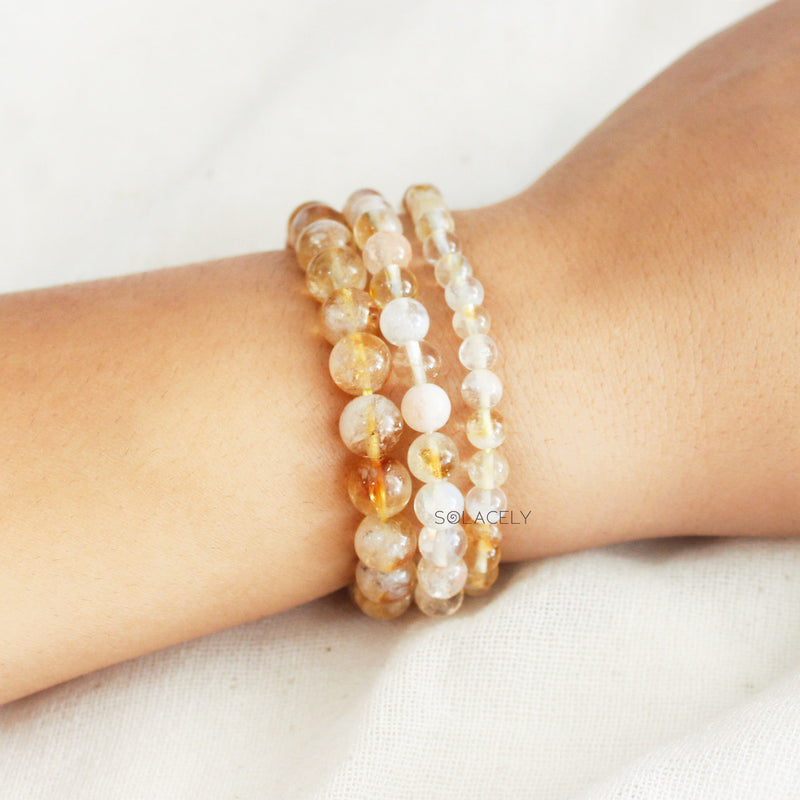
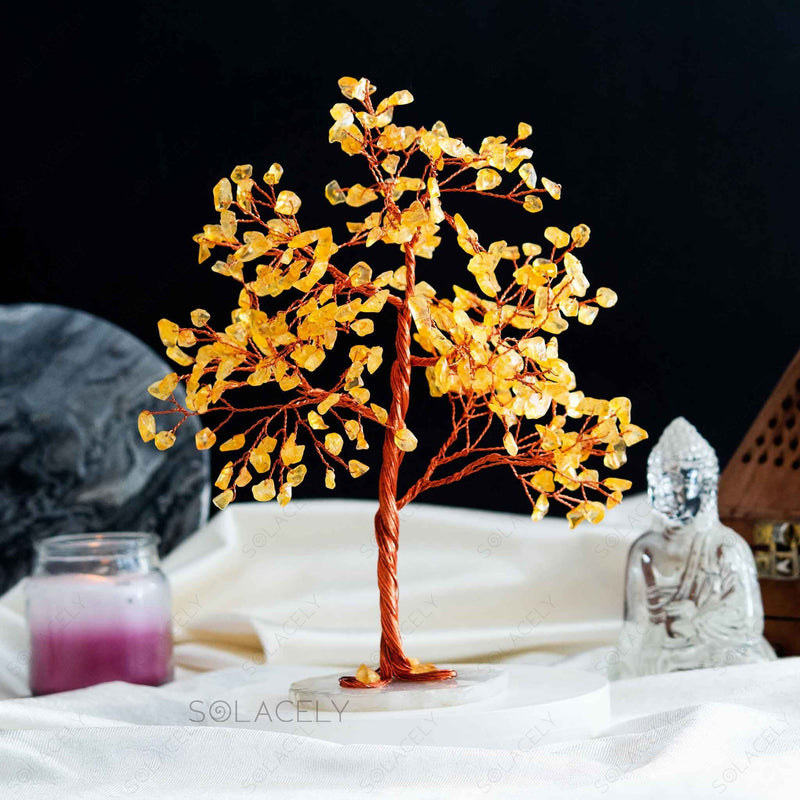
Citrine is quartz in the yellow to orange range, coloured by traces of iron. Shades run from pale lemon through honey to a deep brandy tone. Gemmological reference works list it alongside topaz as a November birthstone. It carries a long merchant tradition: kept in a till or a purse as a daily cue for abundance. Our full guide to citrine meaning, benefits and properties goes further into how it is used.
Tiger's eye
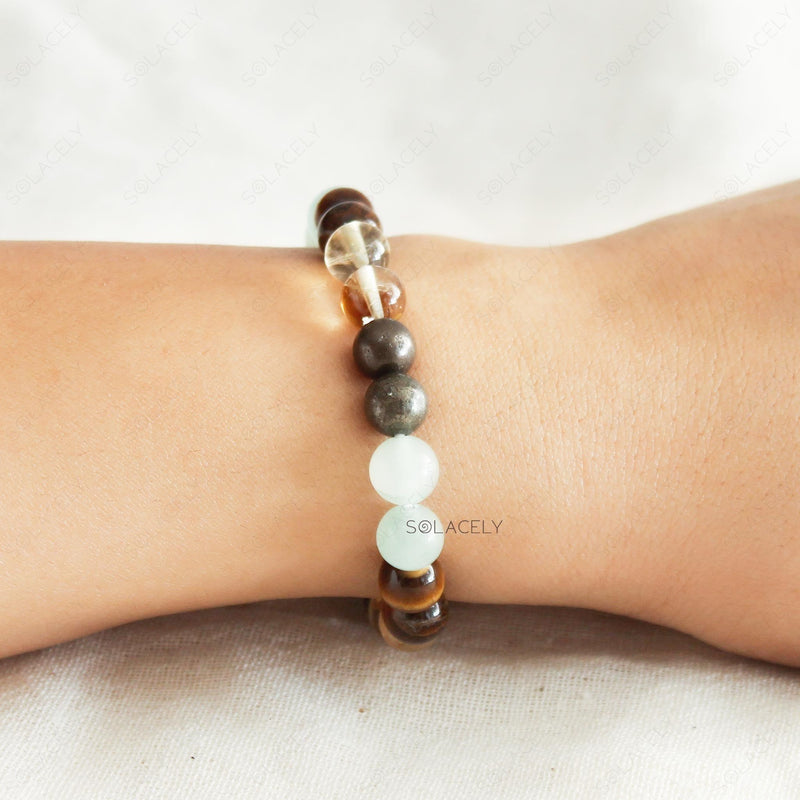
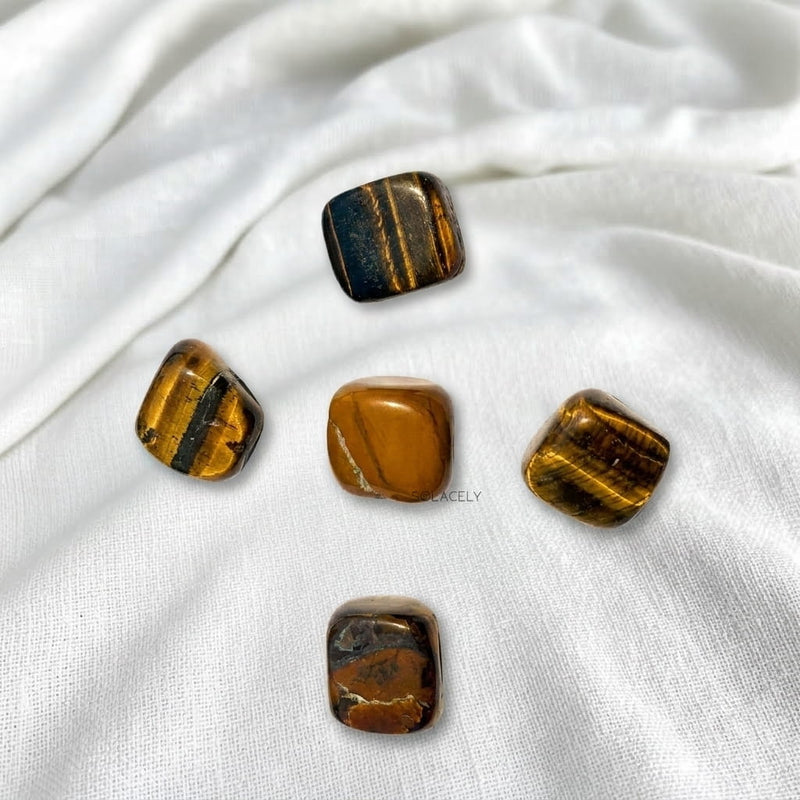
Tiger's eye is a banded quartz with a silky band of light that rolls across the surface as you tilt it. That effect, called chatoyancy, comes from a fine parallel fibrous structure inside the stone. The colour is a warm golden brown, often with darker chocolate stripes. It is one of the most durable gold stones for daily wear, and traditionally kept for courage and steadiness under pressure. There is more in our guide to tiger's eye meaning and properties.
Golden rutilated quartz
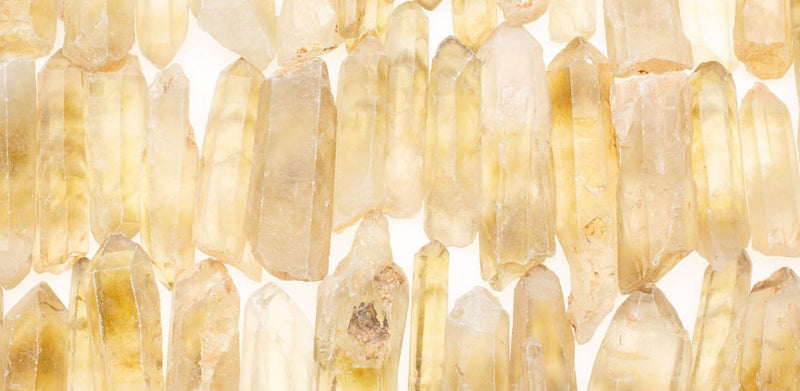
Golden rutilated quartz is clear or smoky quartz threaded with fine golden needles of rutile, a titanium mineral. No two pieces carry the same pattern. Some hold a loose scatter of hairs, others a dense golden net. People reach for it when they want a sense of clear direction rather than a general lift.
Which gold crystals sit outside the quartz family?
Five: pyrite, imperial topaz, gold sheen obsidian, amber and sunstone. They run from the hardest stone here at Mohs 8 down to the softest at 2 to 2.5, so they want quite different handling. What holds them together is that same warm register, from brassy metal to honey.
Pyrite
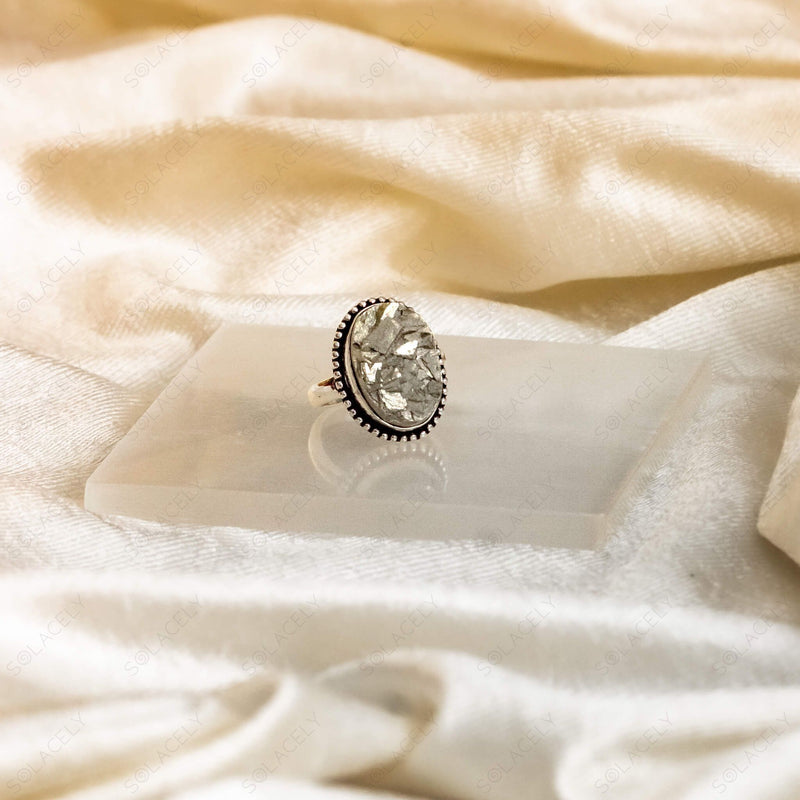
Pyrite is an iron sulphide with a brassy metallic lustre and a hardness of 6 to 6.5. It grows in remarkably crisp cubes and twelve sided forms, which is why raw specimens look almost machined. It is heavier in the hand than most stones this size. Keep it dry. Traditionally it is kept for confidence and steady, practical effort, and you can read more in our guide to pyrite meaning, benefits and properties.
Imperial topaz
Imperial topaz is the aristocrat of the group. The colour runs golden orange through to a warm peachy pink, and at Mohs 8 it is harder than quartz. The catch is cleavage: topaz splits cleanly in one direction, so it wants a protective setting and no sharp knocks. It is a November birthstone and is traditionally worn for warmth and self worth.
Gold sheen obsidian
Gold sheen obsidian is volcanic glass. Tilt it under a single light source and a golden shimmer sweeps across the polished face, produced by microscopic inclusions lined up in the same plane. At roughly 5 to 5.5 it can chip at the edges, so it suits cabochons, spheres and palm stones better than rings. It is traditionally kept for clarity of purpose.
Amber
Amber is fossilised tree resin, hardened over millions of years. It is the outlier here: organic rather than mineral, very light for its size, and warm against the skin almost immediately. At Mohs 2 to 2.5 it marks easily, so treat it as an occasional piece. It has been worn as a comfort stone for as long as people have made jewellery.
Sunstone
Sunstone is a feldspar shot through with tiny platy inclusions that catch the light and throw off a metallic glitter. The effect is called aventurescence, and the body colour ranges from champagne to a rich orange. Material from Oregon carries copper. At 6 to 6.5 it wears well in pendants and earrings. See our guide to sunstone meaning and properties for its traditional uses.
How do you choose the gold shade you want?
Choose by eye, in daylight, next to the metal you plan to wear it with. Gold runs from pale lemon through honey and butterscotch to a deep reddish brandy. Cooler lemon tones read crisp against silver. Warmer amber and brandy tones sing against yellow gold. That single decision matters more than anything else.
Warming quartz to draw out its golden tones is a long established and entirely stable practice across the coloured stone trade, and it is part of why citrine is available in such a wide palette. The shade you see in a finished piece is the shade it keeps. So pick the one you actually want to look at every morning, rather than the one that photographs best.
Goldstone belongs in this conversation too. It is a copper flecked glass made by a technique refined in Venice centuries ago, and it is prized for exactly what it is: a dense field of glittering copper points, cut and polished like a gemstone. Nothing natural reproduces that particular starfield, which is why it has stayed popular for generations.
What are gold crystals traditionally used for?
Abundance, confidence and warmth are the three intentions that follow this colour everywhere. In crystal tradition, gold and yellow stones answer to the solar plexus, the centre just above the navel associated with will, self worth and personal power. Citrine, pyrite and tiger's eye are the usual choices for that work.
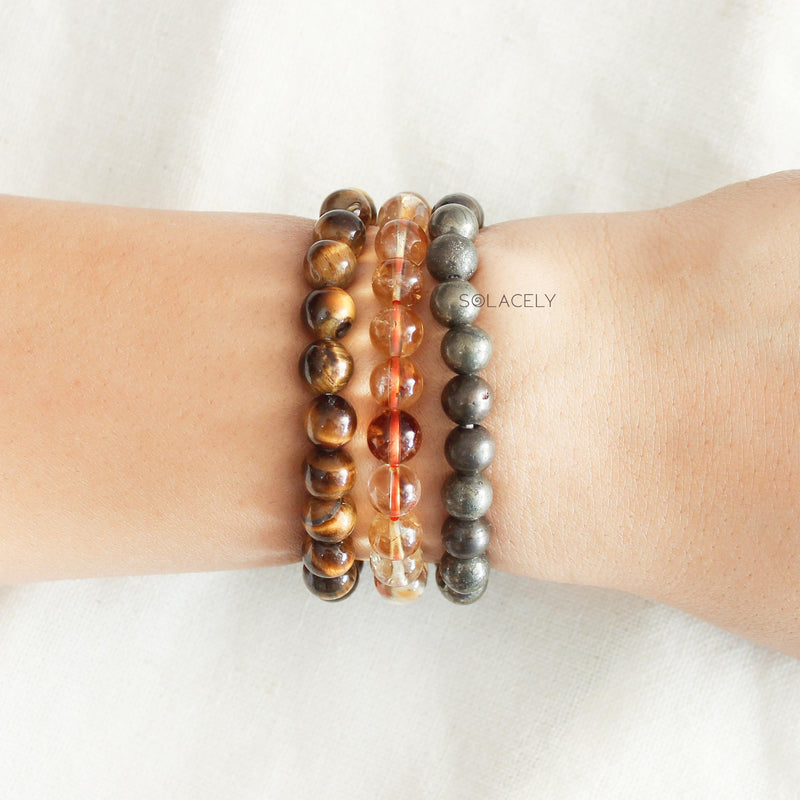
In practice, placement is simple and quite personal. Many people keep a citrine cluster or a pyrite cube on a desk, where it sits in view during the working day. A tumble in a purse or a cash drawer is the older merchant habit. A bracelet keeps the stone on your wrist, which is the version most people find easiest to stay consistent with.
Sunstone and amber tend to be used a little differently. Both are reached for in flat, grey stretches, when the point is warmth rather than drive. Golden rutilated quartz is the one people pick up when a decision is pending and they want the choice to feel clearer. The stone keeps the intention in view, and that is enough.
How do you care for gold crystals?
Care splits by hardness and by chemistry. The quartz members at Mohs 7 are the easy ones: lukewarm water, mild soap, a soft cloth. Pyrite must stay dry. Amber at 2 to 2.5 is the most delicate thing on the list, and topaz, despite being the hardest, is the one most easily damaged by a knock.
Keep pyrite out of the bathroom and away from damp storage. Moisture dulls that mirror bright surface over time, and a dry cloth is all it ever needs. Amber should meet no perfume, hairspray or solvent, so put it on last and take it off first, and keep it out of ultrasonic cleaners. Gold sheen obsidian is glass and chips at the edges, so store it apart from harder pieces.
Two more habits are worth building. Citrine and amber both prefer to be kept out of prolonged strong sunlight, since long exposure can pale a warm colour. And store imperial topaz in its own pouch, because a single hard tap in the wrong direction is all its cleavage asks for.
Finally, the practical safety notes. Do not put stones in water you intend to drink. Keep small tumbles and beads away from young children, since they are a choking risk. Check bracelet elastic every few months, since a strand that lets go on a hard floor is how most tumbles get chipped.
Crystals are traditional and spiritual objects, not medical devices. Nothing here is medical advice, and no crystal treats, cures or prevents any condition. If you have a health concern, please speak to a qualified doctor or healthcare professional, and never delay or stop treatment on the strength of a stone. Keep small stones and beads away from young children and pets, as they present a choking risk, and do not place crystals in water you intend to drink.
Sources
Written by Chetena Sharma. Reviewed by the Solacely editorial team.
Frequently asked questions
About the author


Written by Chetna Sharma, crystal healing practitioner and co-founder of Solacely. Chetna has worked with healing crystals for over a decade and curates Solacely's protective stone collection.