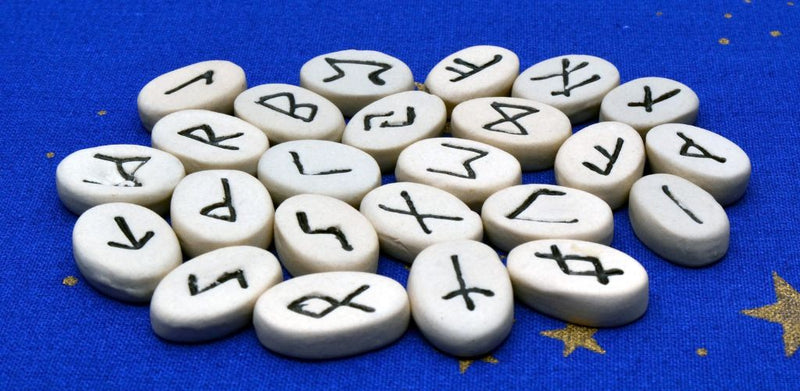
Rune symbols are the letters of the Elder Futhark, the oldest runic alphabet used by early Germanic and Norse peoples from around the 2nd century CE. Each of its 24 runes carried both a sound and a name, and in later tradition each name became a keyword, so Fehu reads as wealth, Uruz as strength, and so on.
Key Takeaways
- Runes are an ancient alphabet, not a mystical invention. The Elder Futhark holds 24 runes, each a letter with a name, and the names became the meanings people read today.
- The word Futhark comes from the sound values of the first six runes: F, U, Th, A, R, K. The system is grouped into three sets of eight called aettir.
- In tradition each rune has a keyword, for example Fehu (wealth), Uruz (strength), Ansuz (communication), Raidho (journey), and Berkano (growth). This is belief and folklore, not fact.
- Runes were used for writing, memorial stones, and later for casting or divination. The most famous full set appears on the Kylver stone in Sweden, dated to about 400 CE.
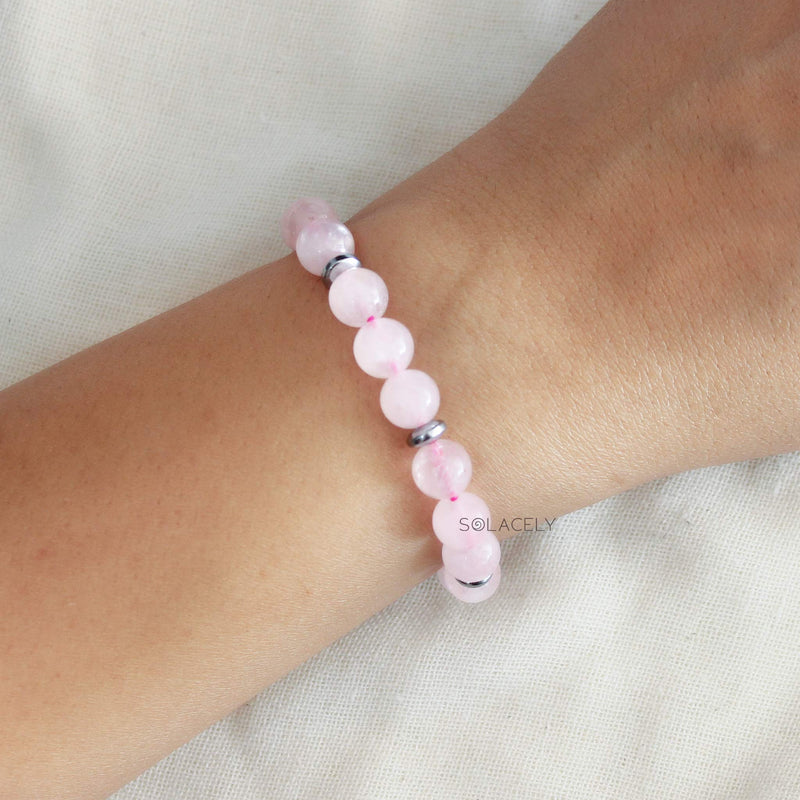
- Modern rune sets are usually amethyst, rose quartz, clear quartz or black obsidian tumbles, sold as a pouch of 24 or 25 stones, with wooden sets often cheaper.
This page is the hub for rune meanings. Below you will find the history, the full 24-rune table, and how runes are read and kept. For themed sets, jump to our guides on runes for protection, abundance, love, and more.
What are rune symbols?
Rune symbols are characters from the runic alphabets used across northern Europe before and alongside the Latin script. Each rune is both a letter and a named concept. According to Encyclopaedia Britannica, runes were used by Germanic peoples from about the 3rd century CE for inscriptions, and the earliest, most complete alphabet is the Elder Futhark of 24 signs.
The shapes look angular and sharp for a practical reason. Runes were carved into wood, bone, stone, and metal, so straight strokes were far easier to cut than curves. You rarely see a horizontal line either, because it would run along the grain of a wooden stave and split or disappear.
A single rune could stand for a sound in a word or for the whole idea named by that rune. Ansuz meant the 'a' sound, but its name pointed to a god and, by extension, to speech, breath, and wisdom. That double life, letter plus keyword, is why runes later became a tool for reflection and casting rather than only for writing.
The history of the Elder Futhark
The Elder Futhark is the ancestor of every later runic system, in use from roughly the 2nd to the 8th century CE. Its name is not a word but an acronym, taken from the sounds of its first six runes: F, U, Th, A, R, K. The complete 24-rune sequence survives most clearly on the Kylver stone in Gotland, Sweden, dated to around 400 CE.
Runes did not appear out of nowhere. Most scholars trace them to a northern Italic or Latin alphabet adapted by Germanic speakers, then reshaped for carving. Over centuries the script travelled with trade and migration, leaving inscriptions on weapons, jewellery, combs, and standing stones from Scandinavia to the edges of the Roman world.
As spoken languages changed, the alphabet changed with them. In Scandinavia the 24 runes were compressed into the 16-rune Younger Futhark of the Viking Age. In England and Frisia they expanded into the Anglo-Saxon Futhorc of up to 33 runes to catch new vowel sounds. The Elder Futhark remained the shared root of all of them.
In Norse myth the runes carry a story of hard-won knowledge. The god Odin is said to have hung on the world-tree Yggdrasil for nine nights, wounded and fasting, until the runes revealed themselves to him. It is a legend, not history, but it captures how these signs were treated: as wisdom that costs something to gain.
The three aettir: how the 24 runes are grouped
The Elder Futhark is traditionally split into three groups of eight runes, each called an aett (plural aettir, meaning family or group). This is not decoration. The grouping helped people memorise the order and later gave rune readers a rough thematic map of the alphabet.
Each aett is named after the first rune in the set. Freya's aett opens with Fehu and leans toward creation, resources, and beginnings. Heimdall's aett opens with Hagalaz and leans toward disruption, testing, and endurance. Tyr's aett opens with Tiwaz and leans toward people, growth, and the wider world.
The table below gives every rune its name, letter sound, and the keyword tradition attaches to it. Read these keywords as folklore and reflection prompts, not predictions.
The full rune meanings table: all 24 Elder Futhark runes
Here is the complete Elder Futhark in traditional order, grouped by aett. Each rune has a name, a sound value, and a widely cited keyword meaning. According to standard references on the Elder Futhark, these names and sound values are well documented, while the divinatory keywords come from later folklore and modern practice.
Freya's aett (runes 1 to 8): resources and beginnings
| Rune | Name | Sound | Traditional meaning |
|---|---|---|---|
| ᚠ | Fehu | F | Cattle, wealth, abundance, earned prosperity |
| ᚢ | Uruz | U | Wild ox, strength, health, raw vitality |
| ᚦ | Thurisaz | Th | Thorn, giant, defence, a sharp obstacle |
| ᚨ | Ansuz | A | A god, breath, speech, wisdom, insight |
| ᚱ | Raidho | R | Wagon, riding, journey, rhythm, right action |
| ᚲ | Kenaz | K | Torch, fire, knowledge, craft, revelation |
| ᚷ | Gebo | G | Gift, exchange, partnership, generosity |
| ᚹ | Wunjo | W | Joy, harmony, comfort, belonging |
Heimdall's aett (runes 9 to 16): forces and testing
| Rune | Name | Sound | Traditional meaning |
|---|---|---|---|
| ᚺ | Hagalaz | H | Hail, sudden disruption, an uncontrolled force |
| ᚾ | Nauthiz | N | Need, hardship, constraint, resilience |
| ᛁ | Isa | I | Ice, stillness, a pause, things held in place |
| ᛃ | Jera | J | Year, harvest, cycles, reward for patience |
| ᛇ | Eihwaz | Ei | Yew tree, endurance, a link between worlds |
| ᛈ | Perthro | P | Lot-cup, chance, mystery, the unknown |
| ᛉ | Algiz | Z | Elk, protection, a shield, higher connection |
| ᛊ | Sowilo | S | Sun, success, energy, guidance, wholeness |
Tyr's aett (runes 17 to 24): people and the world
| Rune | Name | Sound | Traditional meaning |
|---|---|---|---|
| ᛏ | Tiwaz | T | The god Tyr, justice, courage, sacrifice |
| ᛒ | Berkano | B | Birch, growth, birth, nurture, fertility |
| ᛖ | Ehwaz | E | Horse, movement, trust, steady progress |
| ᛗ | Mannaz | M | Humanity, self, community, cooperation |
| ᛚ | Laguz | L | Water, flow, intuition, the unconscious |
| ᛜ | Ingwaz | Ng | The god Ing, seed, potential, gestation |
| ᛞ | Dagaz | D | Day, dawn, breakthrough, awakening |
| ᛟ | Othala | O | Ancestry, home, heritage, inherited wealth |
The rune shapes shown here use standard Unicode runic characters, so the exact glyph will vary a little with your device font. What stays constant is the name and the keyword, which is what most rune readers actually work with.
How runes were used, then and now
Runes served three broad purposes across their history: everyday writing, marking and memorial, and later, casting or divination. Most surviving inscriptions are practical, an owner's name on a comb, a maker's mark on a brooch, a memorial line on a stone. The idea of runes as a fortune-telling deck is largely modern.
For centuries runes were simply how you wrote things down where the Latin alphabet had not yet taken hold. Memorial rune-stones, especially across Sweden, record names, journeys, and deaths, and they are some of our best sources for the script.
Divination as we know it today, drawing runes from a pouch and reading their meanings, took its current shape in the 20th century within New Age and neo-pagan revival movements. It borrows the historical names and shapes but arranges them into a modern reflective practice. It is fair to enjoy it as a tradition-inspired ritual rather than an ancient one.
If you want to explore specific themes, the spokes below break the meanings down by intention. Read runes for prosperity and runes for success for goal-setting, runes for fertility and runes for spirituality for growth and reflection, and Viking rune symbols or Celtic rune symbols for the cultural background.
How to read runes: a simple beginner method
A basic rune reading uses a small set of stones or wooden tiles, a question held in mind, and a spread of one to three runes. There is no single correct method, so treat the steps below as one gentle, widely used approach rather than a rulebook.
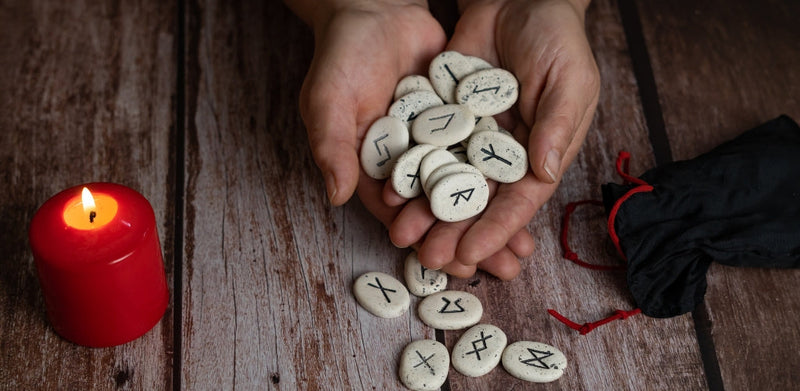
Start with a clear, open question. Runes suit reflective prompts, 'what should I focus on this week', better than yes-or-no demands. Hold the question in mind while you mix the runes in their pouch or bag.
Then draw and read:
1. Single rune. Draw one rune for a quick focus or a daily prompt. Read its keyword and sit with how it applies. 2. Three runes. Draw three and read them as past, present, and future, or as situation, action, and outcome. 3. Reversed runes. Some readers treat an upside-down rune as a softer, blocked, or inward version of its meaning. Not all runes are reversible, and this step is optional. 4. Journal it. Note the runes and your reading. Over time the notes matter more than any single draw.
Keep the tone honest with yourself. A rune reading works best as a mirror that helps you name what you already sense, not as a forecast to obey. Nothing it shows should override medical, financial, or legal advice from a professional.
Choosing and caring for a rune set
A good starter rune set has all 24 Elder Futhark runes, ideally 25 including one blank 'Odin' or 'Wyrd' stone that some traditions add. Crystal rune sets in amethyst, rose quartz, clear quartz, or black obsidian are the most common, with wooden or bone sets usually cheaper.
Pick a material you like handling. Clear quartz and amethyst are popular first choices, while black obsidian and black tourmaline appeal to those drawn to protection symbolism. Wooden runes feel closer to the historical originals and are lighter to carry. There is no 'correct' stone, so choose by feel and budget.
Care is simple and mostly practical:
- Keep them together. A drawstring pouch or a small wooden box stops runes getting lost and keeps the set complete.
- Clean gently. Wipe stones with a soft dry cloth. Avoid soaking soft or porous stones, and keep obsidian and glassy stones away from hard knocks.
- Refresh them your way. Many people like to rest a set on a windowsill in moonlight or hold it briefly before a reading. Treat this as a calming ritual, not a mechanical requirement.
- Handle regularly. A set you actually use becomes familiar, and familiarity is what makes readings feel meaningful over time.
One well-made set is plenty. You do not need multiple decks or expensive kits to read runes, and a modest pouch of tumbled stones does everything a beginner needs.
Sources
- Encyclopaedia Britannica, the runic alphabet, its history and the Elder Futhark. britannica.com
- Encyclopaedia Britannica, Germanic religion and mythology, Odin and the runes. britannica.com
Frequently asked questions
About the author


Written by Chetna Sharma, crystal healing practitioner and co-founder of Solacely. Chetna has worked with healing crystals for over a decade and curates Solacely's protective stone collection.