A fool's gold rock is pyrite, the iron sulphide mineral FeS2. It is brass yellow, opaque and brightly metallic, it grows in near perfect cubes, and it sits at 6 to 6.5 on the Mohs scale. Pyrite forms worldwide, and it is traditionally kept for ambition, follow through and prosperity.
Key takeaways
- Pyrite is iron sulphide, FeS2, brass yellow with a bright metallic lustre and a greenish black streak.
- Mohs hardness is 6 to 6.5, harder than window glass, though the mineral is brittle and has no cleavage.
- It crystallises in the cubic system, which is why you see cubes, pyritohedrons and octahedra, often with striped faces.
- Specific gravity runs roughly 4.9 to 5.2, so a small piece feels surprisingly heavy in the hand.
- It forms in hydrothermal veins, black shales, coal seams and metamorphic rock on every continent.
- Care is simple and non negotiable: pyrite contains iron, so keep it dry, never salt cleanse it and never soak it.
What is a fool's gold rock?
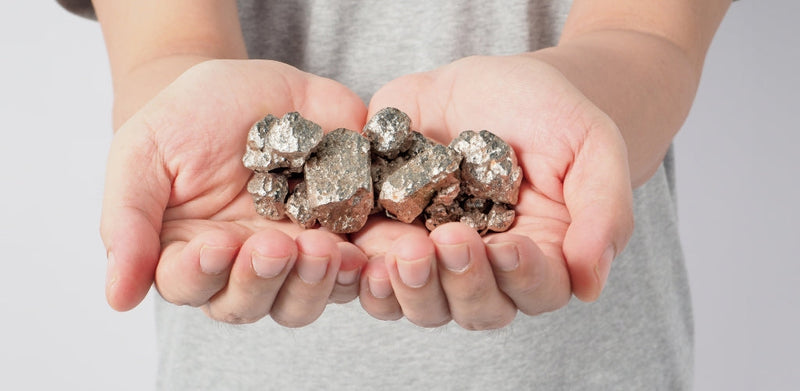
A fool's gold rock is a specimen of pyrite, the iron sulphide mineral FeS2. It is brass yellow, opaque and metallic, it measures 6 to 6.5 on the Mohs scale, and it feels heavy for its size. Collectors keep it for its geometry, its shine and its long association with drive.
The mineral name has nothing to do with the nickname. Pyrite comes from the Greek word for fire, because a piece struck against steel throws sparks. That property gave it a working life long before anyone put it on a shelf: it was used in early wheellock firearms, and later mined at scale as a source of sulphur for industry.
The nickname arrived later, out of prospecting history, and it stuck because it is memorable. These days pyrite is collected on its own merits. Cut and faceted, it has been set into jewellery for centuries under the trade name marcasite, and those small glittering stones in antique brooches and rings are a craft tradition in their own right. For a fuller look at the stone's meaning, see our guide to pyrite crystal meaning, benefits and properties.
Physically it is easy to describe. Opaque, no cleavage, an uneven to conchoidal fracture, brittle rather than malleable, and a streak that comes out greenish black to brownish black on a porcelain plate. Fresh surfaces are pale brass. Older surfaces often warm into a deeper gold or take on a faint iridescent film.
Why does pyrite grow in cubes?
Pyrite crystallises in the isometric, or cubic, system. Its atoms stack in a repeating cube shaped lattice, and when growth conditions are steady, that internal order shows up on the outside as flat square faces. The result is cubes so sharp they look cut, plus pyritohedrons and octahedra from the same family.
Look closely at a cube and you will usually see fine parallel lines across each face. These striations run at right angles on neighbouring faces, a signature of alternating growth between the cube and pyritohedron forms. Twinned crystals sometimes lock together in the cross shaped arrangement collectors call the iron cross.
Not every habit is angular. In muddy sea floor sediments pyrite often grows as framboids, microscopic clusters of tiny spheres packed like a raspberry. In some coal seams it spreads sideways between shale layers into flat radiating discs, sold as pyrite suns or pyrite dollars. Same mineral, completely different silhouette.
That range is a large part of the appeal. A cubic cluster reads as architecture. A polished slab reads as metal. A sun reads as a small brass flower. If you enjoy choosing stones by their look as much as their meaning, our overview of crystal colour and what each shade is associated with is a useful companion.
How hard is pyrite, and how well does it wear?
Pyrite is 6 to 6.5 on the Mohs scale, according to standard mineralogical hardness references. That puts it above window glass and a knife blade, and just below quartz. Hardness is not the whole story though. Pyrite is brittle, with no cleavage planes, so a sharp knock can chip a crystal edge.
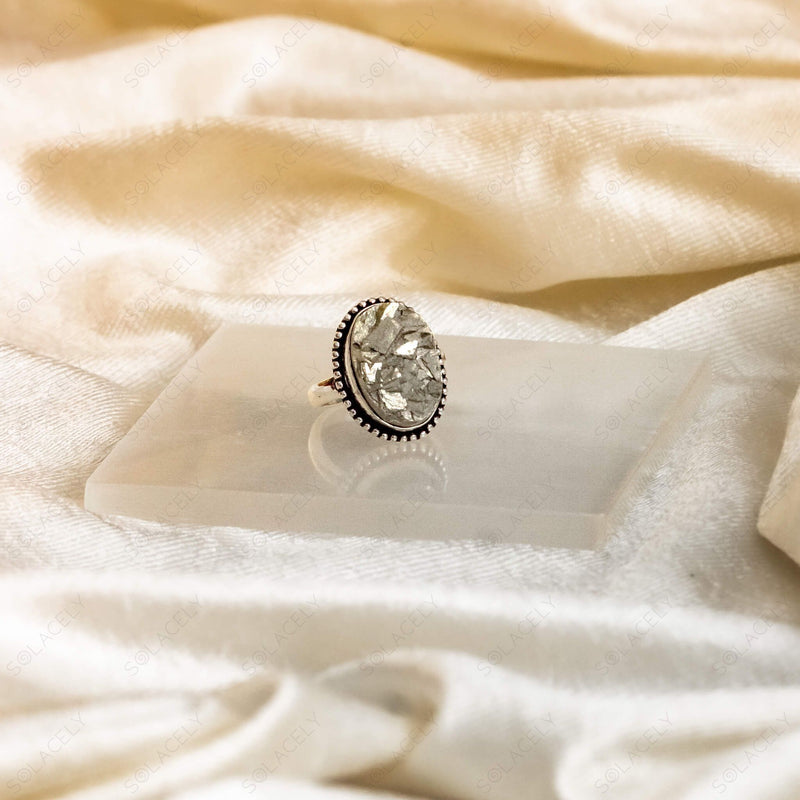
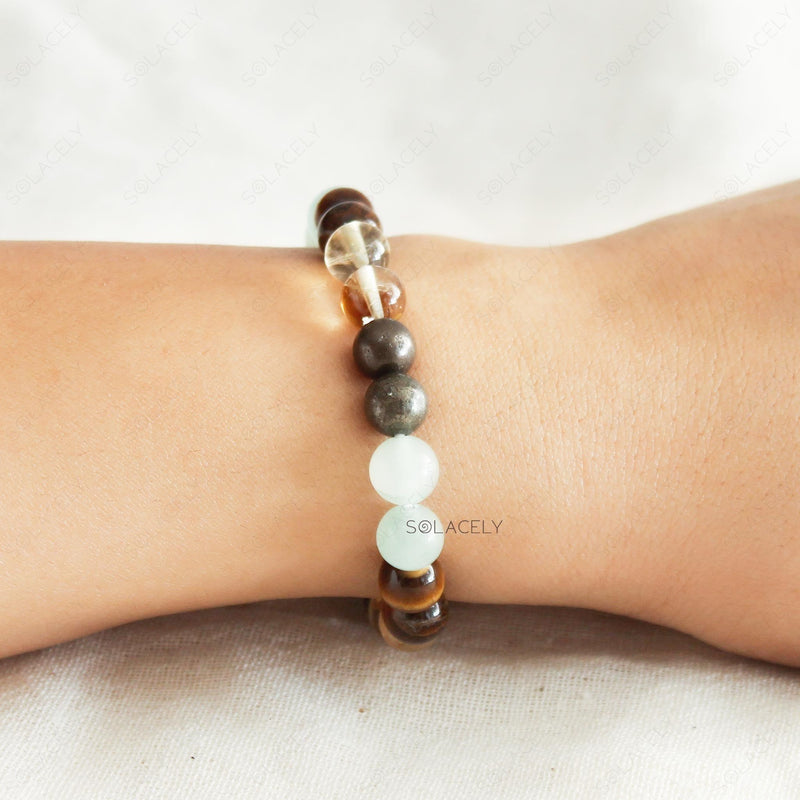
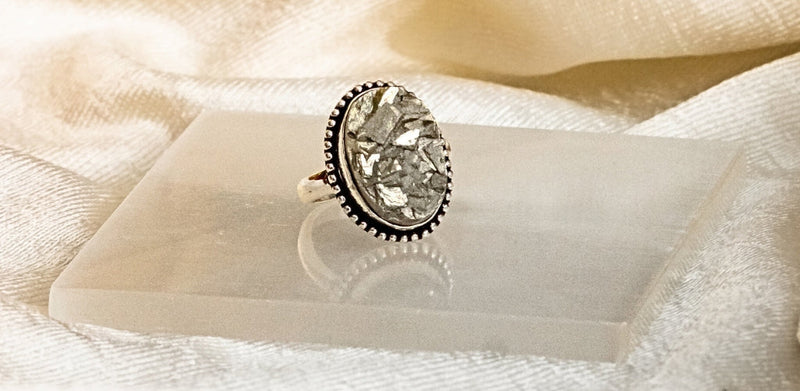
In practice that means pyrite wears well as a pendant, a ring you take off for physical work, or a display piece. It is less suited to a bracelet that meets desk edges and door frames all day. Store it separately from softer stones so its edges do not scratch them.
| Stone | Mohs hardness | Water and salt |
|---|---|---|
| Pyrite | 6 to 6.5 | Keep dry. Never soak, never salt cleanse |
| Quartz | 7 | A brief rinse and a dry cloth is fine |
| Hematite | 5 to 6.5 | Wipe dry, avoid soaking |
| Malachite | 3.5 to 4 | Soft and porous, never soak |
| Selenite | 2 | Dissolves in water, keep dry |
The heft is worth mentioning too. With a specific gravity near five, pyrite is roughly twice as dense as quartz. Pick up a matched pair and the difference is obvious before you look at either one.
Where does pyrite form?
Pyrite is the most widespread sulphide mineral on Earth, and it turns up in almost every geological setting. It crystallises from hot mineral rich fluids in hydrothermal veins, settles into oxygen poor marine muds that harden into black shale, sits in coal seams, and recrystallises during metamorphism.
Different settings produce very different specimens. Vein pyrite tends toward chunky, well formed crystals with strong lustre. Sedimentary pyrite gives you nodules, framboids and the flat discs found in coal measures. Metamorphic pyrite often shows up as scattered cubes embedded in slate or schist, still crisp after being squeezed and reheated.
A few districts are famous among collectors for the quality of their crystals, including the marl quarries at Navajun in Spain, which produce free standing cubes with mirror faces, and several Peruvian mines known for bright clusters. Pyrite also grows alongside quartz, calcite, fluorite and other sulphides, so many specimens arrive as small landscapes rather than single crystals.
What is pyrite traditionally kept for?
Pyrite is traditionally kept for ambition, follow through and prosperity. In crystal tradition it is the stone people reach for when a plan needs finishing rather than starting: the metallic shine is read as momentum, and the cube is read as structure. It is long associated with confidence, willpower and steady work.
Its usual chakra home is the solar plexus, the centre linked with personal power and decisiveness. That is why so many people set a pyrite cube on a desk, keep a tumble in a work bag, or wear a ring on days that call for nerve. Our guide to crystals for the solar plexus chakra covers the wider family of stones kept for the same purpose.
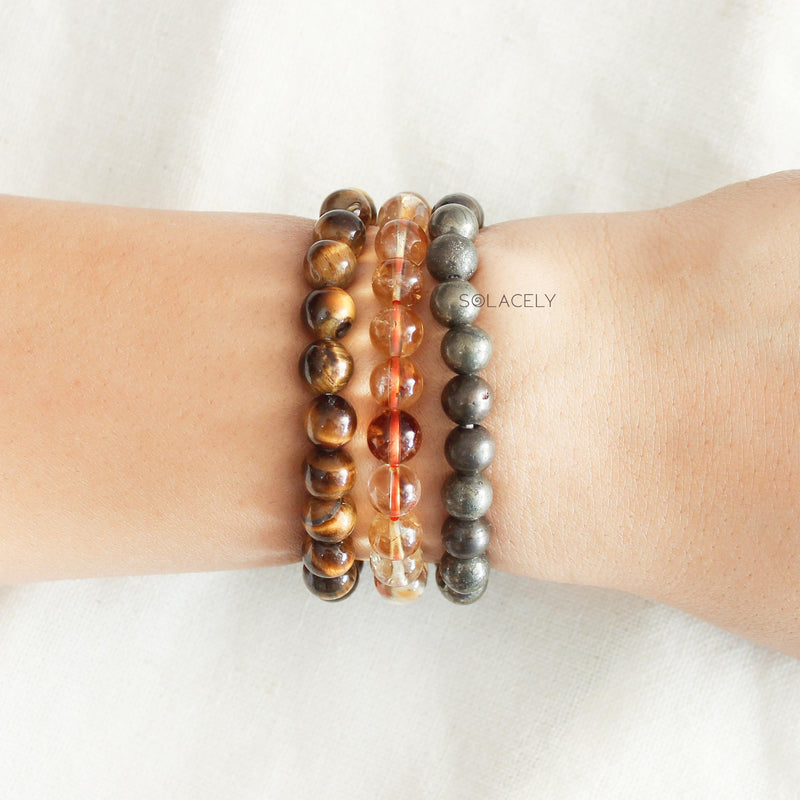
The prosperity association is the other half of its reputation. Pyrite is a classic companion stone in abundance work, often paired with citrine or green aventurine, and it appears in wealth corners, cash boxes and grids built around a specific goal. If you are assembling that kind of setup, our roundup of crystals for prosperity shows how the stones are usually combined.
How you use it matters less than whether you see it. A cube on the desk, a pendant you fasten before a meeting, a piece beside the laptop: each one keeps the intention in view while you do the actual work. Many people find that the visual cue is the point.
How do you care for pyrite so it stays bright?
Keep pyrite dry. This is the one care rule that really matters, because pyrite contains iron, and iron plus moisture plus air means surface rust. Damp storage can leave a piece dull, powdery or streaked with orange. Never salt cleanse pyrite and never soak it, in water, salt water or any solution.
Cleaning is a dry job. Wipe the piece with a soft dry cloth, or lift dust from crystal faces with a clean soft brush. Skip ultrasonic cleaners, steamers and jewellery dips entirely. If you have handled it with damp hands, give it a quick wipe before it goes back on the shelf.
Storage does the rest of the work. A drawer or a lidded box beats a bathroom shelf or a sunny windowsill above a radiator. A sachet of silica gel in the box helps in humid climates. Keep pyrite out of water bowls and away from selenite plates that have been rinsed, and store it apart from softer stones. Our notes on how to care for a pyrite ring go into the jewellery side in more detail.
For cleansing, choose dry methods. Sound, incense or herb smoke, a short spell of indirect moonlight, or simply setting an intention while you wipe the piece down. All of these suit pyrite, and none of them introduce the one thing it dislikes. Wash your hands after handling rough specimens, and keep small tumbles away from young children and pets.
This article is shared for general interest and reflects long standing crystal tradition rather than medical guidance. Crystals are not a treatment for any physical or mental health condition, and they should never replace or delay care from a qualified professional. Keep small stones, beads and tumbles away from young children and pets, as they are a choking hazard. Never place pyrite or any mineral in drinking water, and do not use stones to make elixirs. Wash your hands after handling rough mineral specimens. If you have a health concern, please speak to your doctor.
Sources
Written by Chetena Sharma. Reviewed by the Solacely editorial team.
Frequently asked questions
About the author


Written by Chetna Sharma, crystal healing practitioner and co-founder of Solacely. Chetna has worked with healing crystals for over a decade and curates Solacely's protective stone collection.