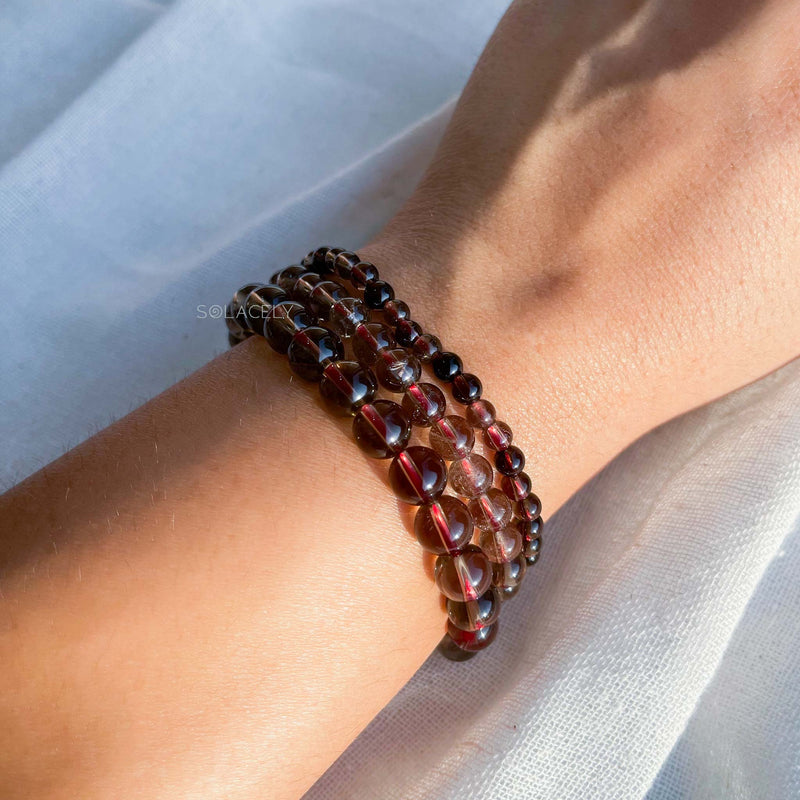
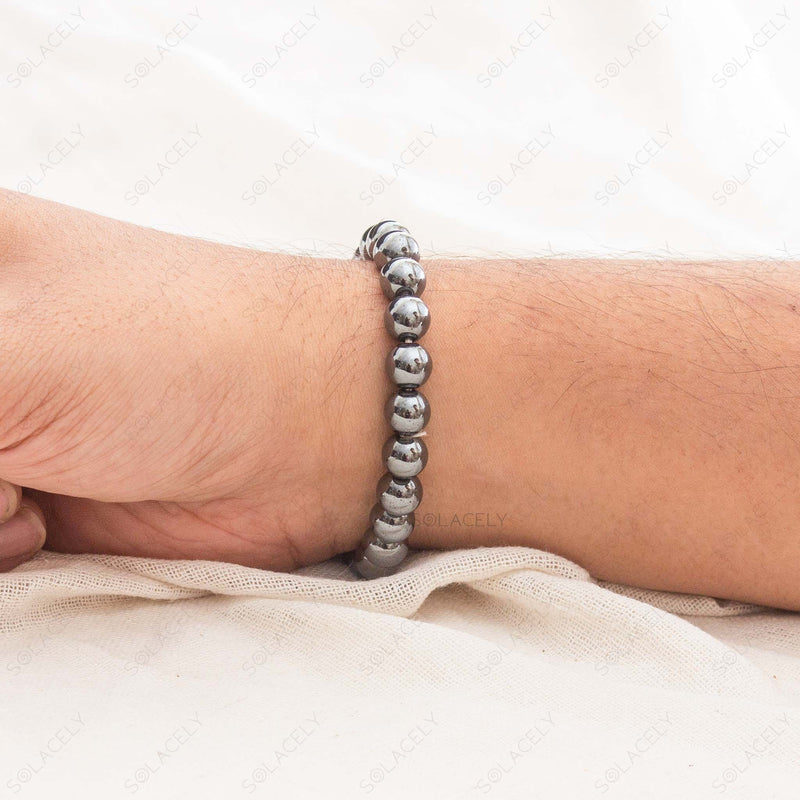
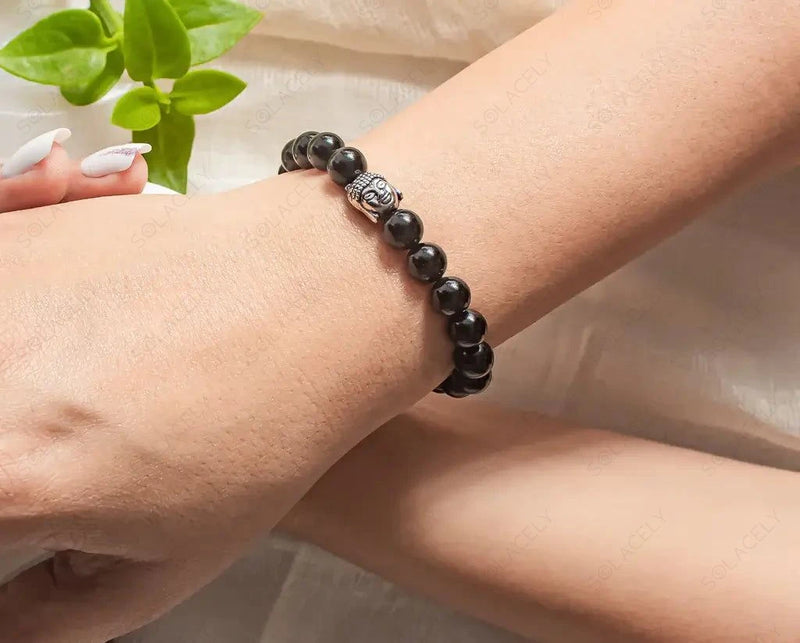
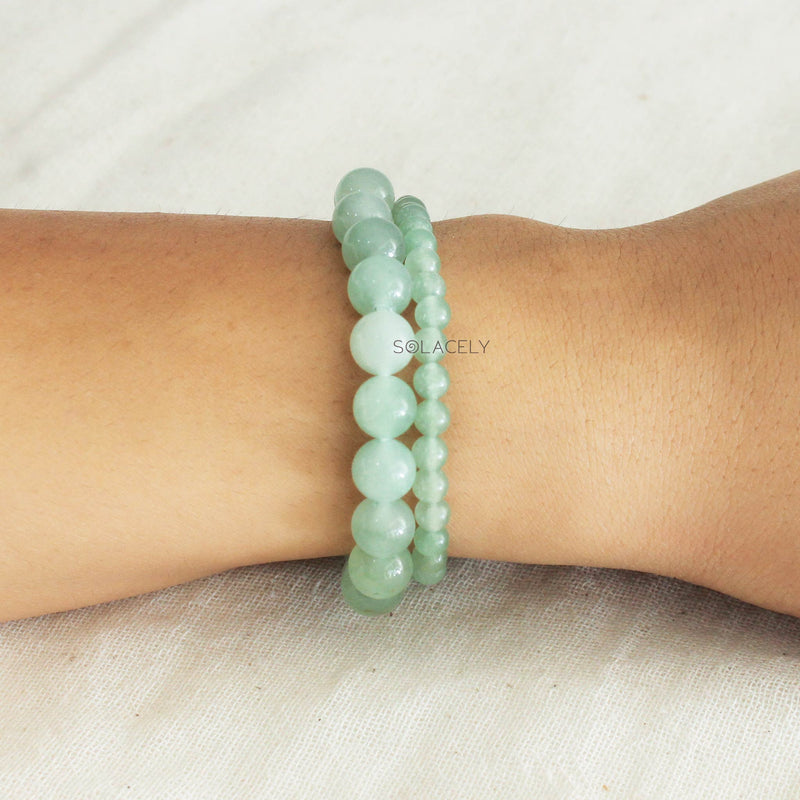
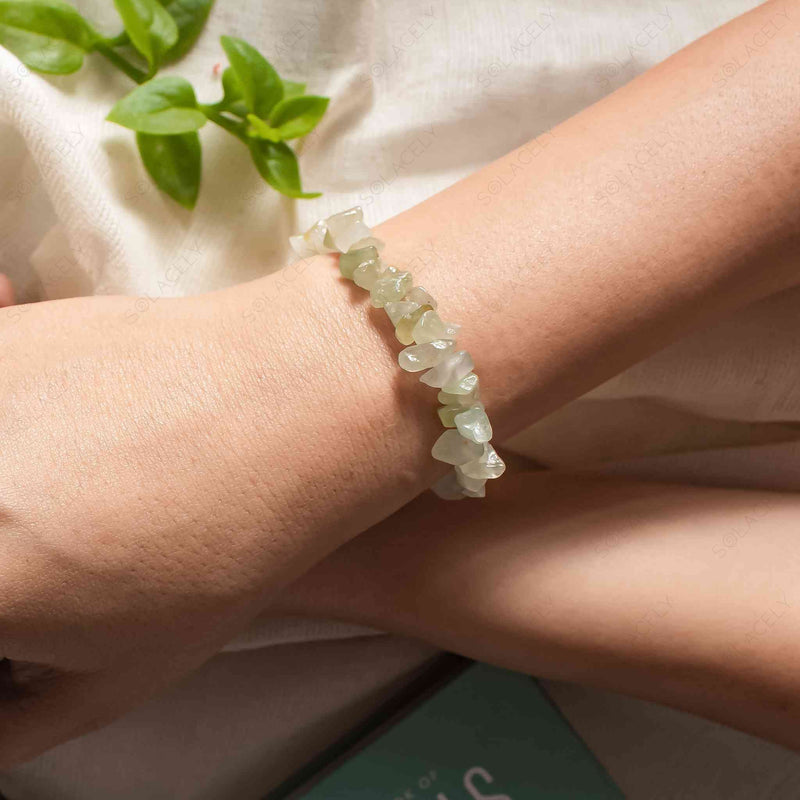
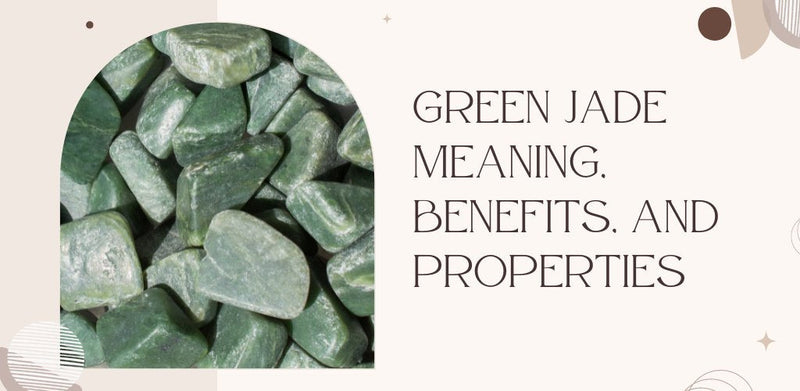
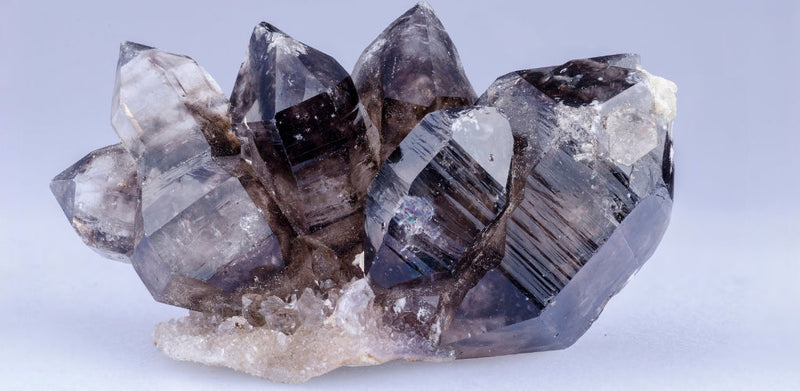
Green jade and smoky quartz is a pairing of opposites that share a job. Jade carries the growth and composure half of the tradition, smoky quartz the grounding and clearing half. Worn together they are used for steady forward movement without the agitation that usually comes with it.
Key takeaways
- Jade is not one mineral. Jadeite and nephrite both qualify as true jade, and much cheap green material is neither.
- Smoky quartz gets its brown from natural irradiation acting on aluminium traces inside quartz.
- Hardness sits close: nephrite roughly 6 to 6.5, jadeite 6.5 to 7, smoky quartz 7. A mixed bracelet wears evenly.
- Traditional reading: jade brings in, smoky quartz takes out.
- Neither stone likes steam or ultrasonic cleaning, and smoky quartz fades in long direct sun.
What the green jade and smoky quartz pairing means
Crystal practice reads most combinations as either reinforcement or balance. This one is balance. Green jade sits on the side of accumulation: prosperity, growth, harmony, the long game. Smoky quartz sits on the side of release: grounding, discharging what has piled up, settling a system that has been running hot. One brings in, one clears out.
That is why the pairing turns up so often for people in a building phase rather than a crisis. Starting a business, studying for something long, rebuilding after a bad year. Jade for the direction of travel, smoky quartz to stop the stress of it accumulating. If you want the individual traditions in full, we cover green jade meaning and properties and smoky quartz meaning and benefits separately.
What green jade actually is
Here is the part most crystal guides skip. Gemmology recognises two entirely separate minerals as true jade: jadeite, a pyroxene, and nephrite, an amphibole. They look similar, they were used interchangeably for millennia, and the two were only formally separated in 1863. Jadeite is rarer and takes the higher polish. Nephrite is more common and is exceptionally tough thanks to its interlocking fibrous structure.
Then there is everything else. A share of inexpensive green beads sold as jade is serpentine, green aventurine, dyed quartzite or glass. None of that is a problem when it is disclosed, and dyed quartzite makes perfectly nice jewellery. It only matters if you paid jade money for it, so buy jade from someone who names the material.
| Green jade | Smoky quartz | |
|---|---|---|
| Mineral | Jadeite or nephrite | Quartz (silicon dioxide) |
| Mohs hardness | 6 to 7 | 7 |
| Colour cause | Iron and chromium traces | Irradiation acting on aluminium traces |
| Traditional role | Growth, prosperity, composure | Grounding, clearing, protection |
| Main care risk | Steam and ultrasonic cleaning | Prolonged direct sunlight |
What smoky quartz actually is
Smoky quartz is ordinary quartz that has been sitting near a source of natural radiation. Where the crystal contains traces of aluminium, that exposure creates a colour centre and the stone darkens to brown, grey or near black. The colour is stable and permanent, and it does not leave the stone radioactive.
The Scottish variety, cairngorm, gave the stone its long association with grounding and endurance in Northern European tradition, and it remains one of the few brown gemstones with a serious historical pedigree.
How to wear the combination
Three formats work, in ascending order of commitment:
- A mixed bead bracelet. The simplest option. Because the two stones are within about a point of each other on the Mohs scale, neither will grind the other down noticeably. Rotate it now and then so wear spreads evenly.
- Two separate bracelets, one per wrist. Traditional practice puts the receiving stone on the left and the releasing stone on the right, which would mean jade left, smoky quartz right. There is no rule behind it, but it makes the intention easier to keep track of.
- Pocket smoky quartz, worn jade. Useful if you want the grounding half available on demand rather than constantly. A tumble in a pocket is something to reach for at a specific moment.
If protection rather than clearing is what you are after, smoky quartz pairs more directly with tourmaline. We cover that in smoky quartz and black tourmaline, and the broader picture is in our guide to crystals for protection.
Caring for both stones
Warm water, mild soap, soft brush, dry properly. That covers both.
The two things to avoid are specific. Skip ultrasonic and steam cleaners, since heat and vibration are hard on any set or treated stone. And keep smoky quartz out of long direct sun, because the same colour centre that irradiation created can be undone by light and heat. A smoky quartz left on a south facing sill for a summer will come back paler.
Who this pairing suits
It suits someone in a long, effortful stretch who does not want to feel wired by it. The combination is deliberately unglamorous: green and brown, matte rather than sparkling, quiet rather than statement. That understatement is part of why it works as an everyday piece rather than something you take off for meetings.
It suits less well anyone looking for a lift in mood or energy. Neither stone is bright in that sense. For that, jade pairs better with a lighter partner, which we cover in green jade and amethyst.
The uses described here reflect traditional and cultural crystal practice. They are not medical claims and are not a substitute for professional healthcare or advice.
Sources
Written by Chetena Sharma. Reviewed by the Solacely editorial team.
Frequently asked questions
About the author


Written by Chetna Sharma, crystal healing practitioner and co-founder of Solacely. Chetna has worked with healing crystals for over a decade and curates Solacely's protective stone collection.